Murti worship, often misunderstood as “idol worship,” is a deeply symbolic and spiritual practice in Hinduism. A murti is not a mere stone or metal object, but a consecrated form through which devotees establish a personal and emotional connection with the Divine. Across India, with hundreds of thousands of temples and countless home shrines, this tradition continues to remain a living expression of devotion, discipline, and faith.
Understanding the Meaning of Murti Worship
In Hindu philosophy, the Divine is understood as both nirguna (formless) and saguna (with form). Murti worship allows devotees to relate to the infinite through a tangible form that supports focus, prayer, and meditation.
The Rigveda beautifully expresses this unity in diversity:
“Ekam sat vipra bahudha vadanti”
Truth is One; the wise describe it in many ways.
This reflects the idea that the same ultimate reality can be approached through different names, forms, and paths. A murti, therefore, is not worshipped as an object, but revered as a medium of divine presence.
Symbolism Embedded in Hindu Murtis
Every murti carries layers of philosophical meaning expressed through form, posture, and attributes.
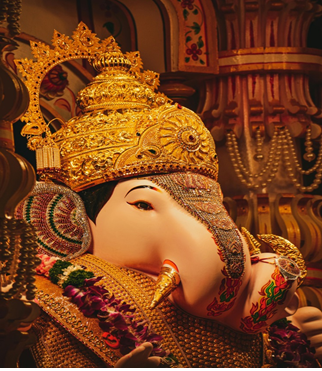
Lord Ganesha: Wisdom in Symbolic Form
Lord Ganesha represents intelligence, clarity, and the removal of obstacles:
- Elephant head: wisdom and discernment
- Large ears: attentive listening
- Small eyes: concentration and focus
- Broken tusk: sacrifice and determination
- Mouse vehicle: control over desires
Each element serves as a reminder of ethical and spiritual values.
Shiva Lingam: The Infinite Principle
The Shiva Lingam symbolizes the formless and infinite nature of existence. It represents creation, preservation, and dissolution as continuous cosmic processes.
A verse from the Yajur Veda states:
“Na tasya pratima asti”
There is no image or form that can fully represent Him.
This highlights that while God transcends all forms, forms still serve as pathways for understanding the divine.
Goddess Durga: Strength and Protection
Goddess Durga, riding a lion, symbolizes courage and the triumph of righteousness over negativity. Her multiple arms represent divine protection in all directions and her victory over inner and outer struggles.
During festivals like Durga Puja, murtis are worshipped with devotion and later immersed in water, symbolizing the impermanence of physical forms and the eternity of spiritual truth.
Prana Pratishtha: Invoking the Divine Presence
Before worship begins in temples, a sacred ritual known as Prana Pratishtha is performed, in which life force is symbolically invoked into the murti through Vedic chants and rituals.
After this consecration, the murti is treated not as an object, but as a living embodiment of the deity. This is reflected in daily temple practices such as:
- bathing the deity
- offering food (naivedya)
- performing aarti
- dressing and adorning the murti
- singing devotional hymns
These rituals foster a deeply personal relationship between devotee and the Divine.
Psychological and Devotional Significance
Murti worship also serves an important psychological function. Human beings naturally connect more easily with visual symbols, and sacred forms help anchor the wandering mind during meditation.
Many spiritual practitioners observe that murti worship enhances:
- concentration
- emotional stability
- mindfulness
- devotional focus
In modern discussions among Hindu practitioners, murtis are often described as “conduits of devotion”—supportive symbols that guide the mind rather than replace the Divine.
Beyond Temples: The Role of Home Worship
Murti worship is not confined to temples. Across millions of Indian households, small home shrines are maintained where daily prayers are performed with lamps, flowers, and incense.
According to contemporary Hindu practice, home worship nurtures:
- discipline in daily life
- gratitude and humility
- emotional grounding
- spiritual awareness within the family
It integrates spirituality into everyday living rather than treating it as a separate ritual activity.
Clearing Misconceptions About “Idol Worship”
The term “idol worship” often misrepresents Hindu practice by implying worship of material objects. In reality, Hindu philosophy distinguishes between an ordinary object and a consecrated murti infused with symbolic and spiritual significance.
A useful analogy is a national flag—it is physically cloth, yet it represents an entire nation and evokes respect. Similarly, a murti represents divine qualities and consciousness, serving as a focal point for devotion.
Philosophical Depth: Form and Formlessness
Hinduism embraces multiple spiritual paths. Some seek the formless absolute through meditation, while others approach the Divine through sacred forms. Both are considered valid and complementary.
- Saguna Brahman: God with attributes and form, accessible through devotion
- Nirguna Brahman: the formless, infinite, and absolute reality
Murti worship belongs to the path of bhakti (devotion), where emotional connection and reverence become tools for spiritual growth.
Conclusion
Murti worship is a profound synthesis of philosophy, symbolism, and devotion. Far from being mere ritual, it is a spiritual discipline that helps transform perception turning form into meaning and matter into mindfulness.
As Swami Vivekananda emphasized, external forms are stepping stones, not destinations. Through murti worship, devotees learn to see the Divine in visible form while ultimately moving toward the realization of the formless truth that lies beyond all representations.