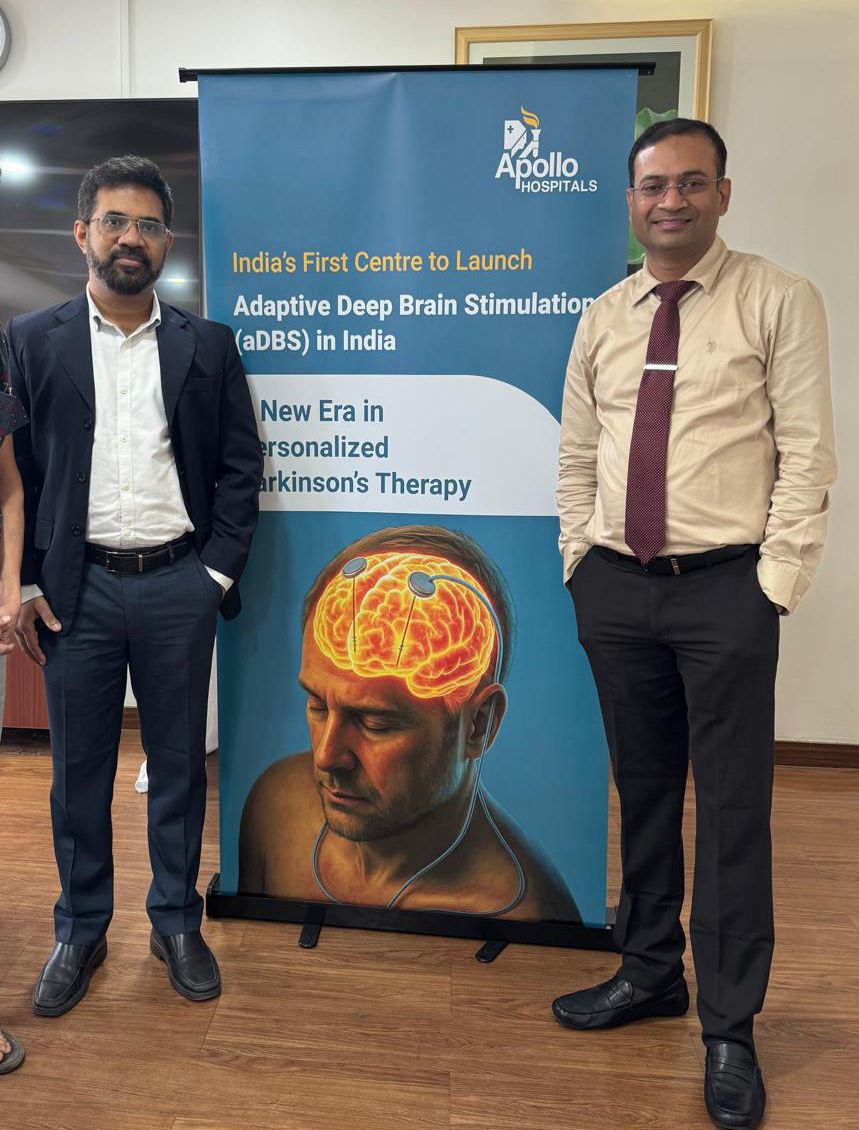
Chennai, India Apr 10: Apollo Hospitals, Chennai announces a major milestone in the treatment of Parkinson’s disease in India, the country’s first clinical activation of Adaptive Deep Brain Stimulation (aDBS). The procedure was carried out on 2 March 2026 by Dr. Vijayashankar Paramanandam, Dr. Arvind Sukumaran, and their team. The programme is led by clinicians with advanced international fellowship training in movement disorders neurology and functional neurosurgery.
A recent British Medical Journal study underscores the rising burden of Parkinson’s disease in India, with an estimated 2.8 million people expected to be living with the condition by 2050 (range 2.3–3.5 million), second only to China and accounting for nearly one-tenth of global cases. South Asia is projected to contribute nearly 6.8 million cases overall. Globally, the Parkinson’s population is expected to reach 25.2 million—up over 112% from 2021 levels—with India alone projected to see a 160–180% increase. Current global prevalence stands at 267 cases per one lakh people.
The milestone builds on the hospital’s established Deep Brain Stimulation (DBS) programme, developed through sustained experience in movement disorders and functional neurosurgery. This follows an initial period of clinical follow-up to assess the patient’s response to the treatment.
Conventional DBS has transformed care for appropriately selected Parkinson’s patients by delivering continuous electrical stimulation to targeted areas of the brain. Adaptive DBS fine tunes it by introducing a more responsive approach, adjusting stimulation in real time based on the patient’s own brain signals. This approach is supported by sensing-enabled neurostimulation systems, including those developed by Medtronic, allowing therapy to better align with fluctuations in symptoms across the day.
Adaptive DBS is an important advance in Parkinson’s therapy,” said Dr. Vijayashankar Paramanandam, Senior Consultant Neurologist & Movement Disorders and DBS Specialist, Apollo Hospitals, Greams Lane-Chennai. “Adaptive DBS represents the next major evolution from conventional, continuous DBS therapy. By actively monitoring the brain’s unique electrical signals, the system responds instantaneously, delivering the precise amount of stimulation exactly when it is needed. This effectively smooths out unpredictable symptoms and improves the quality of life , bringing us closer to truly personalized DBS care.”
“In any new technology, what matters is patient benefit,” said Dr. Arvind Sukumaran, Senior Consultant Neurosurgeon, Apollo Hospitals, Greams Lane- Chennai. “Following activation, programming and clinical follow-up over a month, we have seen encouraging early response in terms of stability throughout the day. That is a meaningful outcome in Parkinson’s, where fluctuation is often the most challenging aspect to manage.” The patient, a 62-year-old male, also reported meaningful improvement. “I feel more stable through the day, and that makes a real difference to daily life,” he said.
Parkinson’s disease is a progressive neurological condition that affects movement, independence, and quality of life. Patients who have lived with the disease for several years, require multiple medications, and experience significant “off” periods or dyskinesias may benefit from timely referral for advanced therapies such as DBS.
Observed every year on April 11, World Parkinson’s Day highlights the need for greater awareness, early diagnosis, and improved access to care. This development reflects the growing role of advanced, physiology-guided therapies in addressing unmet needs in Parkinson’s management in India.
