
New Delhi, Nov 26: Accessing government welfare schemes and services in a preferred Indian language is set to become easier, with the Digital India BHASHINI Division joining hands with the Department of Social Justice and Empowerment to introduce AI-powered multilingual capabilities on its digital platforms.
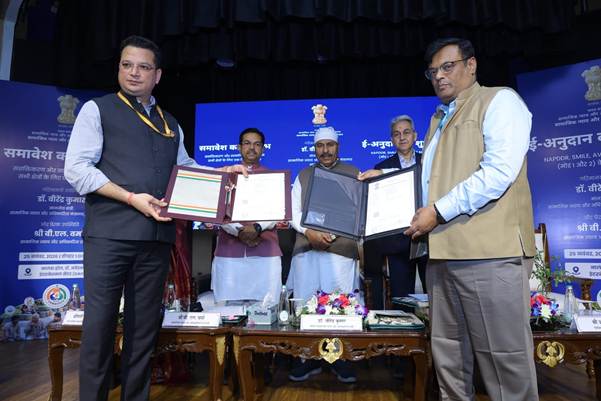
The two organisations exchanged a Memorandum of Understanding (MoU) on Wednesday to integrate BHASHINI's language technology services with SAMAVESH (Single Access Mechanism for All Verticals of Empowerment & Social Harmony), the Department's unified digital gateway for schemes and services.
The integration is expected to enable citizens to access information and services in more than 22 languages, helping reduce language barriers for beneficiaries and other users navigating government platforms. It will also support technology-enabled features such as document summarisation.
Ministers witness MoU exchange
The MoU was exchanged in the presence of Union Minister for Social Justice and Empowerment Dr. Virendra Kumar, Minister of State B. L. Verma, Department Secretary Sudhansh Pant and Digital India BHASHINI Division CEO Amitabh Nag, along with senior officials and representatives of the participating organisations.
SAMAVESH brings together the Department's schemes, services and organisational portals through a single digital interface. By integrating BHASHINI's multilingual tools, the platform aims to make information easier to understand and access for people from different linguistic backgrounds.
AI-powered assistance through Samajik Sahayak
The partnership will also support AI-enabled features on SAMAVESH, including Samajik Sahayak, a chatbot designed to provide information and assistance in more than 22 languages.
The proposed integration of language technologies is intended to help users navigate welfare-related information more conveniently. Features such as translation and document summarisation could make government information more accessible to citizens who may otherwise face difficulties understanding digital content.
BHASHINI expands multilingual digital infrastructure
Speaking on the collaboration, BHASHINI CEO Amitabh Nag said the initiative aims to ensure that language does not become an obstacle to accessing government information and services.
He highlighted the division's work in text, speech and video translation, as well as efforts to bring tribal and underserved languages into the digital ecosystem. These include initiatives to digitise Bhili and develop language technology resources for Mizo.
Nag said BHASHINI also aims to extend its capabilities to government reports, scheme documents and videos, while improving speech accessibility across digital platforms.
According to the division, BHASHINI currently powers more than 800 government websites and has enabled over 11 billion AI inferences. It processes more than 24 million AI inferences daily and supports 36 Indian text languages, 23 Indian voice languages and 35 international languages.
Push for inclusive digital public services
The collaboration brings India's multilingual AI infrastructure into the social welfare delivery framework, with a focus on making public information more accessible across regions and language communities.
It aligns with the government's broader Digital India vision of expanding equitable access to public services through technology. The integration of BHASHINI with SAMAVESH is expected to strengthen the platform's ability to serve citizens in their preferred languages and make digital welfare services more inclusive.