Haryana, Oct 09: What if the agricultural waste left behind after every harvest could become a source of protein?
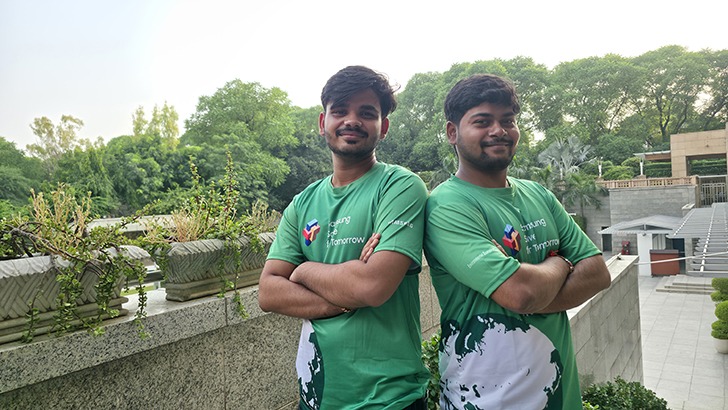
That is the question driving Nitish Kumar and Gulshan Kumar, two young students from Sonipat, Haryana, who are exploring how artificial intelligence and biotechnology can transform crop residue into sustainable protein.
Students at the National Institute of Food Technology Entrepreneurship and Management, Haryana, Nitish and Gulshan are the founders of Kinva Bio, a team among the Top 20 of Samsung Solve for Tomorrow 2026. Their idea addresses one of the biggest challenges facing the world’s food system: how to produce more nutritious food for a growing population without putting greater pressure on land and water.
Their solution starts with agricultural byproducts that are often treated as waste, including sugarcane bagasse. Kinva Bio uses fermentation, in which a fungal strain converts this biomass into protein. An AI-powered digital twin then helps the team predict protein production, allowing them to optimise the process and understand its potential at scale.
According to the team, the approach could use 98–99% less water, significantly reduce carbon emissions and require substantially less land than conventional protein production.
For the two young innovators, however, the journey has been about more than developing a scientific solution. It has been about learning how to turn an idea from the laboratory into something that can make a difference in the real world.
A global problem-solving platform, Samsung Solve for Tomorrow helps youth around the world use STEM to build a better future. Participants identify problems in their communities and develop creative solutions with the help of technology.
Who is the end user?
When Nitish and Gulshan started working on Kinva Bio, their focus was largely on the science behind their innovation.
“We were projecting our idea scientifically and without storytelling,” the team said.
Their experience at the Samsung Solve for Tomorrow Bootcamp changed that perspective. Interacting with mentors, experts and fellow innovators exposed them to questions beyond the laboratory: Who is the end user? What problem are we solving? How do we communicate its impact? And what would it take to turn the idea into a viable startup?
“The biggest takeaway from the Bootcamp was the people we connected with and the exposure to the business environment,” they said.
The team began approaching their pitches differently. Instead of only explaining how their technology worked, they learnt to communicate why it mattered — to consumers, investors and society.
For Nitish and Gulshan, storytelling became more than a presentation skill. It changed the way they looked at Kinva Bio itself — from a scientific project to a potential business capable of creating real-world impact.
From Sonipat to the global food innovation stage
The team’s work had already begun attracting international attention.
The recognition offered the young innovators a glimpse of how far their idea could travel beyond the classroom and laboratory.
Their Samsung Solve for Tomorrow journey has since pushed them to think about the next questions: Who will use the solution? How can it be scaled? What would it take to build a user base? And how can an innovation rooted in biotechnology become a commercially viable solution?
As Kinva Bio moves towards the Grand Finale of Samsung Solve for Tomorrow 2026, Nitish and Gulshan are carrying with them an idea that began with a simple but consequential question: Can we produce more food while asking less of the planet?
For these young innovators from Sonipat, the answer could lie in bringing together AI, biotechnology and agricultural waste — and turning what was once considered residue into a building block for the future of food.