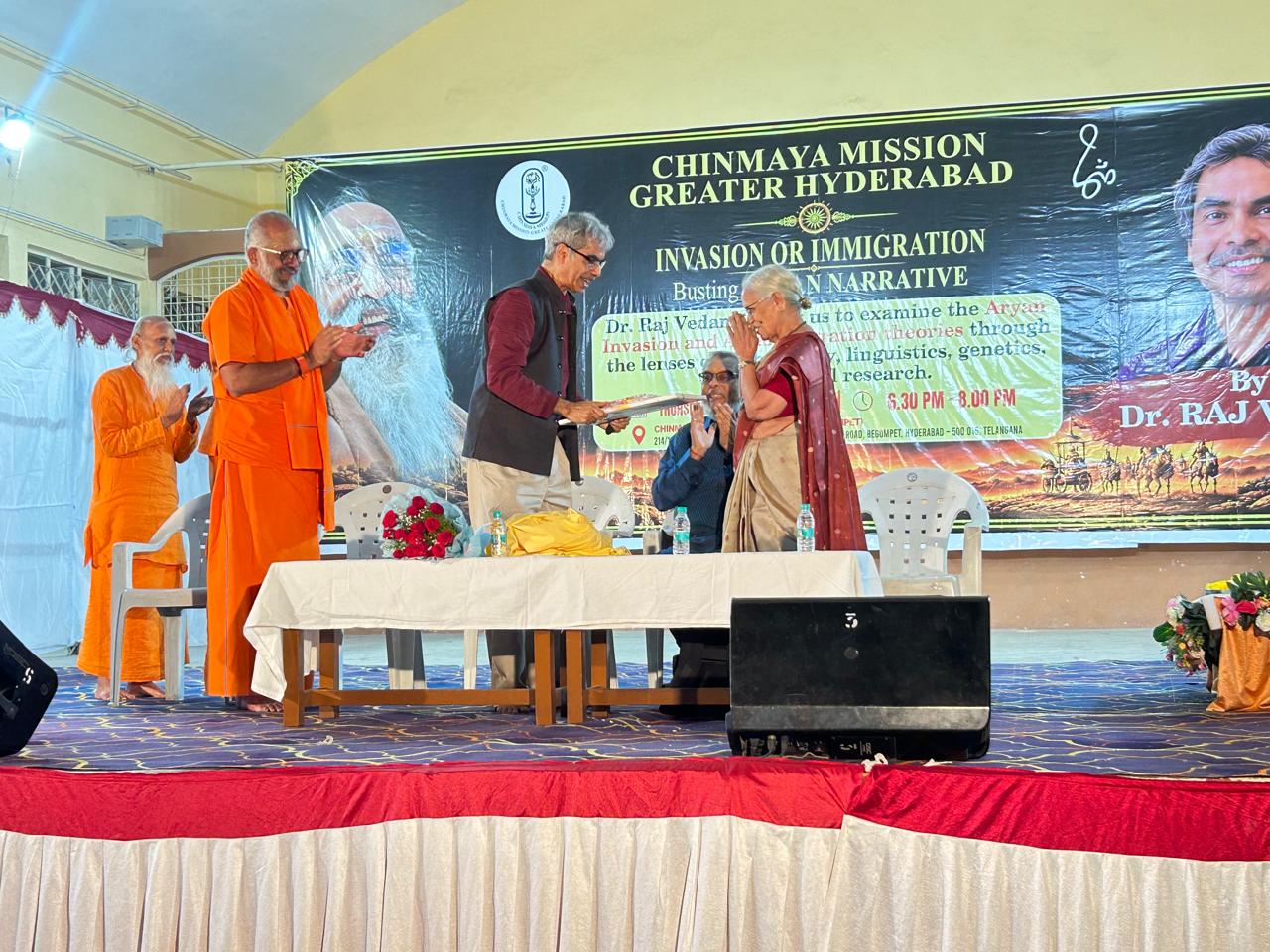
Hyderabad, Nov 13, 2026: Chinmaya Mission Greater Hyderabad hosted a lecture by Dr Raj Vedam, an engineer, researcher and speaker based in Houston, USA, on “The Origin of Hindus: Exploring the Deep History of Indian Civilization.” Dr Vedam examined the Aryan invasion and migration theories and argued that they deserve fresh, evidence-based scrutiny. He has delivered more than 300 lectures across India and the USA, and his work draws on genetics, linguistics, archaeology and other disciplines. The Chinmaya Mission Greater Hyderabad acharye Incharge, Swami Sarveshananda as also present.
Speaking on the occasion, Swami Sarveshananda, Acharya-in-charge of Chinmaya Mission Greater Hyderabad, said,"Why should we learn about Indian culture and its epics (*itihasas*)? Because without understanding these epics, we cannot comprehend the present; and without understanding the present, we cannot envision a bright future.
To help us gain a deeper, more accurate understanding of this culture, Raj Vedam has joined us today—traveling all the way from Houston, USA. Although he was here for other professional commitments, he graciously accepted our invitation to be with us.
Learning about our identity and civilization empowers us to further enrich and promote our Indian heritage on a global scale. We extend our heartfelt gratitude to Raj Vedam for providing us with this wonderful opportunity.
Why identity matters
Dr Vedam opened by asking what it means to be an Indian beyond saluting the flag, watching cricket or Bollywood, and enjoying Indian food. He said many Indians cannot connect to the civilisation they inherit, and he attributed this to a narrative of recent origins that, in his view, has left people “deracinated.” He argued that understanding who framed this narrative, why, and on what evidence is essential.
A model-based approach
Dr Vedam described his method as that of an engineer, treating every historical claim as a “model,” an abstraction of reality, and examining its assumptions, constraints and data provenance. He applied this to the linguistic model underlying the Aryan theory, tracing it from William Jones’s observation that Sanskrit, Latin and Greek are related, through Max Müller’s Proto-Indo-European proposal, to Mortimer Wheeler’s reading of the Harappan ruins as evidence of invasion.
Linguistics under the lens
According to Dr Vedam:
The invasion idea faded after excavations at Mohenjo-daro and Harappa showed no evidence of city-wide destruction, and was replaced by a “migration” theory.
Proto-Indo-European is a hypothetical, reconstructed language with no inscriptions, books or artefacts.
Reconstructions such as the word for “wheel” rely heavily on Sanskrit data, which he called circular reasoning.
The “sound laws” used in comparative linguistics were generalised from some European languages without independent validation.
The distribution of “centum” and “satem” words contradicts the neat east-west split the theory assumes. He cited Balto-Slavic, Tocharian and Proto-Bangani as examples.
Five frameworks shaping history
Dr Vedam identified five agencies that, he said, shaped the writing of Indian history, colonial, missionary, Eurocentric, socialist and Marxist. He argued each had its own motives, such as upholding Biblical chronology, promoting conversion, asserting European superiority. He said the resulting narrative presents India as a young civilisation whose knowledge came from elsewhere, and that it reaches children through textbooks and the media. He called for the “Indic practitioner” to be given a place at the table in discussions of Indian civilisation.
Four lines of evidence
1. Textual and traditional evidence. Dr Vedam noted that no major Indian text or tradition, from the Puranas to the Sangam memory of Kumari Kandam, records an invasion or migration into India. He cited the Bhagavata Purana’s account of the Dravida king who became Vaivasvata Manu, the Solar and Lunar dynasties, and the Rigveda’s Dasarajna battle, which he said hints at outward migrations from India. He also cited the 1920s questions of F.E. Pargiter, a British judge, who asked why such a vast tradition would have been fabricated.
2. Archaeology. He said the Ochre Coloured Pottery record shows continuity from the fourth to the second millennium BCE, with no sign of a new people arriving around 1500 BCE. He pointed to human presence in India across vast spans of time, from stone tools in Tamil Nadu and Attirampakkam to the Narmada skull, underwater sites at Poompuhar and Dwaraka, and the Sarasvati-Sindhu sites.
3. Genetics. Dr Vedam argued that genetic studies are inconclusive on Indian ancestry. He said efforts to separate “Aryan” from “Dravidian” or to map varna onto genes have failed, and that maternal lineages show long-standing continuity in India. He said Y-chromosome and genome-wide studies, including those proposing “Ancestral North Indian” and “Ancestral South Indian” populations, are highly sensitive to sampling and methodology. He also cited the 2019 Deccan College study of Harappan DNA, which he said points to an Indus Valley cline from which most Indians derive.
4. Further disciplines. He indicated that climatology, geology and astronomy offer additional evidence, covered in his 20-hour lecture series at the Hindu University of America.
A call to reclaim the narrative
Dr Vedam urged the audience to apply “rational, logical analysis” to data, methods and claims rather than accept received wisdom. He said the goal is not jingoism but evidence-based inquiry, and expressed hope that attendees would examine the evidence themselves.