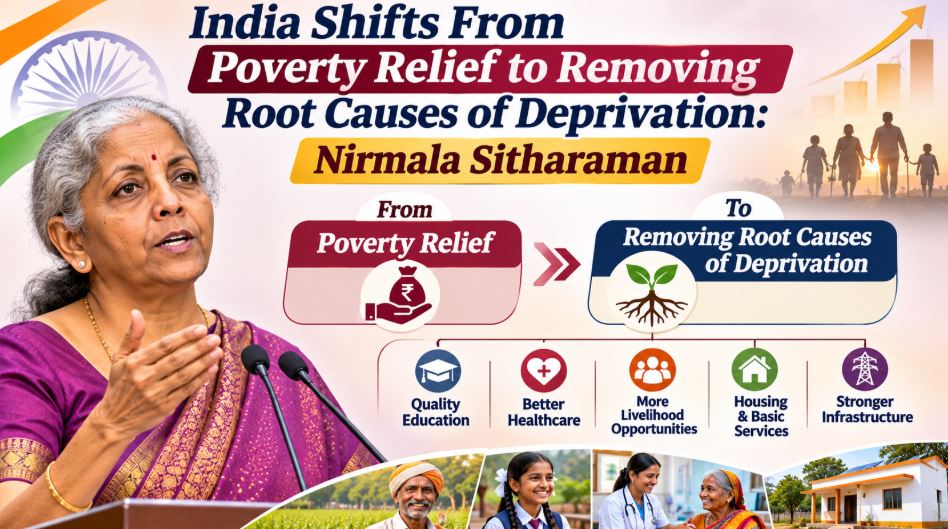
New Delhi, Nov 23: India has undergone a fundamental transformation in its approach to poverty alleviation, shifting from temporary welfare assistance to addressing the structural barriers that keep vulnerable households trapped in poverty, Union Finance Minister Nirmala Sitharaman said on Monday.
Representational Image
Highlighting the country's progress in poverty reduction, Sitharaman said nearly 50 crore people moved out of poverty between 2011 and 2023, while extreme poverty has been almost eradicated, according to the latest World Bank report.
In an article shared on LinkedIn, the Finance Minister said the reported progress reflected a transformation she had witnessed firsthand under the leadership of Prime Minister Narendra Modi.
She said the government's approach over the past decade had focused on identifying specific forms of deprivation and ensuring that welfare interventions reached the households most in need, rather than relying solely on financial assistance.
Recalling India's development challenges in the years following Independence, Sitharaman observed that despite decades of efforts, mass poverty remained a persistent concern. Even in the early 2010s, millions of households continued to face inadequate sanitation, poor nutrition, lack of clean cooking fuel and limited access to banking services.
The government's approach, guided by the principle of Antyodaya — reaching the last person in the queue — marked a significant departure from earlier poverty alleviation strategies, she said.
According to the Finance Minister, welfare programmes were designed around targeted beneficiaries, measurable outcomes and effective delivery mechanisms. Identifying eligible households, removing implementation bottlenecks and ensuring that benefits reached the last beneficiary became central to the development strategy.
She also credited the Prime Minister's direct monitoring of flagship programmes and the use of technology for improving delivery and accountability.
Welfare schemes tackle multiple dimensions of poverty
Highlighting the impact of flagship initiatives, Sitharaman said the Swachh Bharat Mission had significantly expanded household toilet access, improving sanitation and helping avert an estimated 60,000 to 70,000 infant deaths annually.
The Jal Jeevan Mission has expanded rural household tap-water connections from around three crore in 2019 to nearly 16 crore, reducing the burden on women and girls who previously had to travel long distances to fetch water. The initiative has also helped reduce exposure to waterborne diseases.
She cited the Pradhan Mantri Ujjwala Yojana for providing cleaner cooking fuel, the Pradhan Mantri Awas Yojana for improving access to permanent houses and Ayushman Bharat for offering financial protection against major healthcare expenses.
Together, these initiatives have helped reduce household vulnerabilities, lower out-of-pocket expenditure and free up time for productive activities, she said.
Direct transfers and financial inclusion strengthen delivery
The Finance Minister also highlighted the role of digital technology and financial inclusion in improving the delivery of government assistance.
Recalling the earlier system in which only a fraction of public funds reportedly reached intended beneficiaries, she said Direct Benefit Transfer (DBT) had significantly improved transparency by transferring welfare assistance directly into bank accounts.
More than 59 crore Jan Dhan accounts have helped expand financial access and facilitate direct delivery of government benefits, reducing the role of intermediaries.
She further pointed to the impact of the Pradhan Mantri MUDRA Yojana, under which around 60 crore loan accounts have been sanctioned, with women accounting for approximately two-thirds of the beneficiaries.
Programmes such as PM SVANidhi and PM Vishwakarma have also extended financial and institutional support to street vendors and traditional artisans, enabling them to strengthen their livelihoods.
Women emerging as drivers of economic growth
Sitharaman highlighted women's economic participation as another important dimension of India's poverty reduction efforts.
More than 3.7 crore women have become Lakhpati Didis through livelihood initiatives linked to Self-Help Groups, with some progressing towards becoming Crorepati Didis.
She also cited the Namo Drone Didi initiative, under which trained women are providing drone-based agricultural services to farmers, creating new income opportunities in rural areas.
According to the Finance Minister, these initiatives demonstrate how women who were earlier excluded from economic opportunities are increasingly becoming entrepreneurs, service providers and independent income earners.
Viksit Bharat 2047 remains the next milestone
Emphasising that the country's development journey is far from complete, Sitharaman said the next phase of poverty alleviation must focus on reaching those who remain at the bottom of the economic ladder while ensuring that families who have moved out of poverty do not slip back into deprivation.
She said the goal of building a developed India by 2047 requires sustained commitment, collective participation and continued improvements in living standards.
Referring to Prime Minister Narendra Modi's vision of Viksit Bharat, the Finance Minister said India had achieved in a decade what remained unfulfilled for several decades after Independence.
With the collective resolve of 140 crore Indians, she expressed confidence that the goal of Viksit Bharat by 2047 was within the country's reach.
The Finance Minister's remarks underline the government's emphasis on combining welfare delivery, infrastructure, financial inclusion and livelihood generation to address poverty not merely as a lack of income, but as a wider problem of limited access to basic services and economic opportunities.