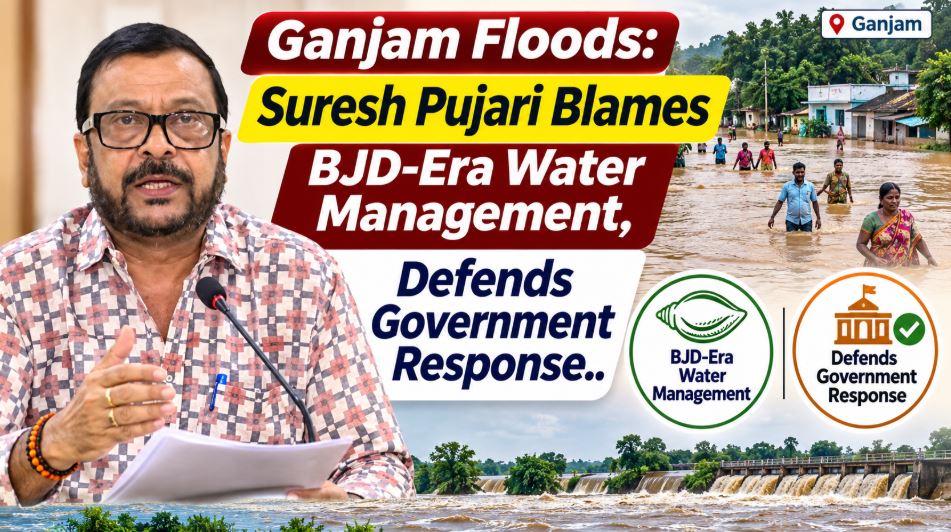
Bhubaneswar, Nov 12 (UDN): Odisha Revenue Minister Suresh Pujari has blamed alleged shortcomings in water management during the previous 24-year Biju Janata Dal (BJD) government for the recent flood crisis in Ganjam district following Cyclone Arnab.
Representational Image
Addressing a press conference on Thursday, Pujari questioned the management of rivers and dams in the district and accused the Opposition of shifting responsibility onto the present government instead of addressing its record in office.
He challenged the BJD to present its arguments with facts during the upcoming Assembly session, asserting that the administration had taken precautionary measures based on weather forecasts but faced an exceptionally intense spell of rainfall.
Ganjam receives 337.6 mm rain in three days
According to figures shared by the minister, Ganjam district recorded 337.6 mm of rainfall between October 28 and 30. The daily rainfall was 83.1 mm on October 28, 191 mm on October 29 and 63.4 mm on October 30.
The situation was particularly severe in Patrapur block, which received a cumulative 808.4 mm of rainfall during the three-day period.
Patrapur recorded 89.4 mm on October 28, followed by an exceptionally heavy 546 mm on October 29 and another 173 mm on October 30.
Pujari said several other blocks also experienced intense rainfall, with one block receiving more than 500 mm, two recording over 400 mm and around six blocks reporting rainfall exceeding 300 mm.
He described the rainfall as unprecedented for the district and said its intensity contributed significantly to the sudden flooding.
Minister cites forecast-based preparedness
Defending the government's handling of the situation, Pujari said preparations had been made in accordance with forecasts issued by the India Meteorological Department (IMD). However, the actual rainfall intensity reportedly exceeded the anticipated levels, worsening the situation.
He also said the system for releasing water from rivers had been automated, while acknowledging that certain events, including rocks falling from hills, could not always be anticipated.
The minister maintained that the state government's priority during disasters was to minimise casualties. Citing previous cyclone-related fatalities, he said 72 people had died during Cyclone Titli and 65 during Cyclone Fani.
Eight ministers assigned to oversee relief efforts
Pujari said eight ministers had been given responsibilities to monitor the flood response in Ganjam and oversee the government's efforts in the affected areas.
He also indicated that the state government would consult various Indian Institutes of Technology (IITs) to explore technical and long-term solutions for managing floods and reducing the impact of extreme rainfall.
The government is looking at ways to strengthen disaster preparedness and improve flood management in the future.
The minister's remarks have brought water management and disaster preparedness into focus, with the ruling government and the Opposition expected to face questions over the causes of the Ganjam floods and the measures needed to prevent similar crises.