Exploring the Shakti Peethas: 51 Sacred Seats of the Divine Feminine Across South Asia
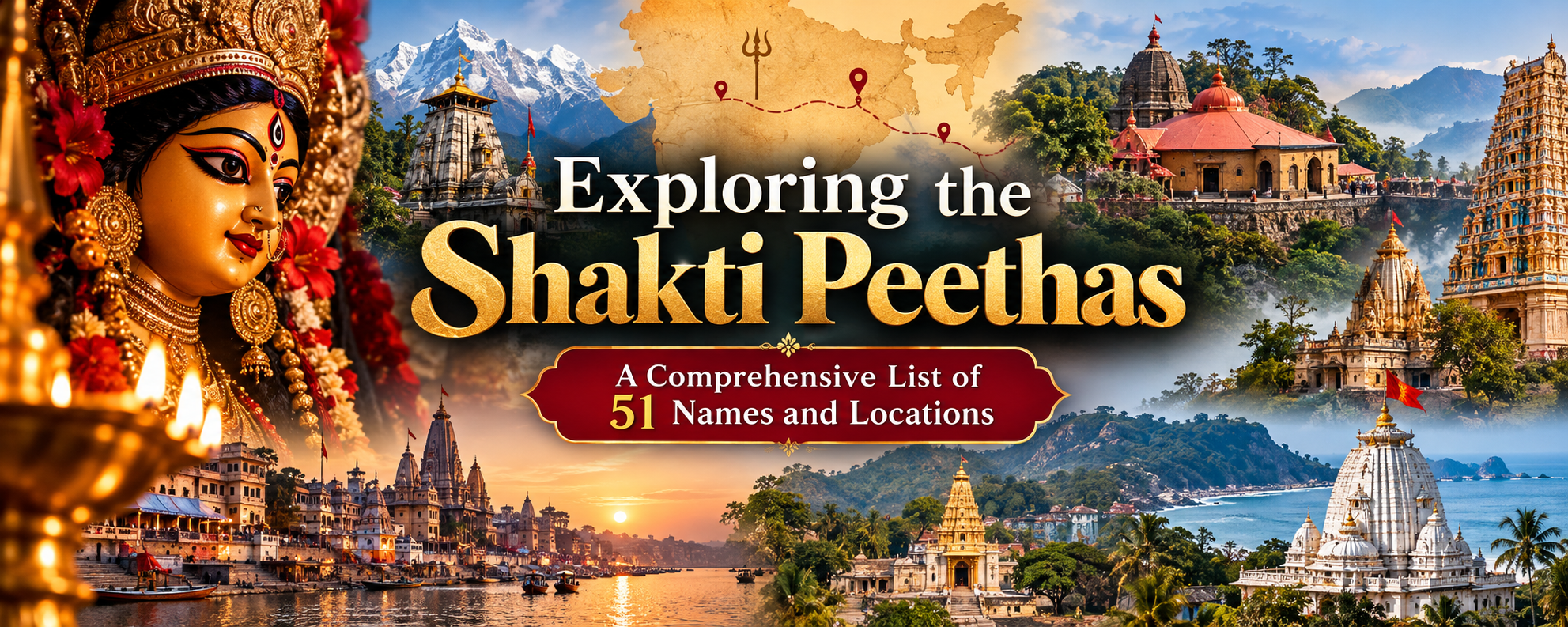
Across the Indian subcontinent, there exists a remarkable sacred geography shaped not by political boundaries, but by mythology, devotion and the enduring presence of the Divine Feminine.
From the Himalayan landscape to the eastern plains, from the deserts of western India to the southern coastline, and from the sacred hills of Assam to temples beyond India's present-day borders, the Shakti Peethas form one of the most fascinating pilgrimage networks in Hinduism.
Tradition identifies 51 principal Shakti Peethas, each associated with the Goddess in one of her many manifestations. These sacred places are linked to the ancient story of Sati, Shiva and the cosmic grief that followed Sati's death.
Yet the Shakti Peethas are much more than a collection of temples.
They represent an idea: that the Divine Feminine is present throughout the landscape of South Asia, appearing in different names, forms and traditions while remaining one Shakti.
The Story That Created a Sacred Map
The story of the Shakti Peethas begins with Sati, the daughter of King Daksha and the wife of Lord Shiva.
Daksha, according to Hindu tradition, did not approve of Shiva and once organized a grand yajna without inviting him. Sati nevertheless went to the ceremony. When she witnessed the insult directed at her husband, she gave up her life in the sacrificial fire.
Shiva was devastated.
Carrying Sati's body, he began a cosmic journey of grief. His sorrow and anger threatened the balance of creation. To restore cosmic order, Lord Vishnu intervened with his Sudarshana Chakra.
As the divine weapon separated Sati's body, different parts and ornaments were believed to have fallen at different places across the subcontinent.
These locations became known as Shakti Peethas — the seats of Shakti.
The story transformed geography into mythology. A mountain became sacred. A riverbank became a pilgrimage destination. An ancient settlement became associated with the Goddess. A natural flame became a manifestation of divine energy.
The result was a sacred network unlike any ordinary pilgrimage map.
Why 51?
The number 51 has a special place in Shakta and Tantric traditions.
It is traditionally connected with the 51 Sanskrit letters, suggesting a deeper philosophical association between the Goddess, sound, language and creation.
However, there is no single universally accepted list of Shakti Peethas.
Different Hindu texts and regional traditions mention different numbers, including 4, 18, 51, 52, 64 and 108.
Consequently, the names, locations, body parts and forms of the Goddess associated with individual Peethas can vary between traditions.
This diversity is important. The Shakti Peetha tradition developed over centuries, incorporating ancient texts, local temple traditions and regional devotional practices.
The list of 51 presented here therefore represents a traditional framework rather than a modern archaeological register.
The 51 Shakti Peethas
Below is a publication-friendly overview of the traditionally cited 51 Peethas and their commonly associated modern locations. Several identifications remain debated.
| No. | Shakti Peetha | Traditional/Modern Association |
|---|---|---|
| 1 | Hinglaj | Balochistan, Pakistan |
| 2 | Karavira | Kolhapur, Maharashtra |
| 3 | Sugandha | Bangladesh |
| 4 | Kashmir | Kashmir region |
| 5 | Jwalamukhi | Himachal Pradesh |
| 6 | Jalandhara | Punjab |
| 7 | Vaidyanatha | Deoghar, Jharkhand |
| 8 | Nepal | Nepal |
| 9 | Manasa | Manasarovar region |
| 10 | Viraja | Jajpur, Odisha |
| 11 | Gandaki | Nepal |
| 12 | Bahula | Ketugram, West Bengal |
| 13 | Ujjayini | Ujjain, Madhya Pradesh |
| 14 | Chattala | Chittagong, Bangladesh |
| 15 | Tripura | Tripura, India |
| 16 | Trisrota | North Bengal |
| 17 | Kamakhya | Guwahati, Assam |
| 18 | Yugadya | Kshirgram, West Bengal |
| 19 | Kalighat | Kolkata, West Bengal |
| 20 | Prayaga | Prayagraj, Uttar Pradesh |
| 21 | Jayanti | Meghalaya |
| 22 | Kirita | Murshidabad, West Bengal |
| 23 | Varanasi | Uttar Pradesh |
| 24 | Kanyashrama | Kanyakumari region |
| 25 | Kurukshetra | Haryana |
| 26 | Manivedika | Pushkar region, Rajasthan |
| 27 | Shrishaila | Srisailam, Andhra Pradesh |
| 28 | Kanchi | Kanchipuram, Tamil Nadu |
| 29 | Kalamadhava | Amarkantak region |
| 30 | Shona | Son River region |
| 31 | Ramagiri | Traditionally linked with central/northern India |
| 32 | Vrindavana | Vrindavan, Uttar Pradesh |
| 33 | Shuchi | Suchindram region, Tamil Nadu |
| 34 | Panchasagara | Location disputed |
| 35 | Karatoya | Karatoya River region, Bangladesh |
| 36 | Shriparvata | Location disputed |
| 37 | Vibhasha | Tamluk, West Bengal |
| 38 | Prabhasa | Gujarat |
| 39 | Bhairava Parvata | Ujjain region |
| 40 | Janasthana | Nashik region, Maharashtra |
| 41 | Godavari | Godavari region |
| 42 | Ratnavali | Bengal tradition |
| 43 | Mithila | Mithila/Janakpur region |
| 44 | Nalahati | Nalhati, West Bengal |
| 45 | Kalighata | Bengal tradition |
| 46 | Vakreshvara | Bakreshwar, West Bengal |
| 47 | Yashora | Jessore/Jessoreswari, Bangladesh |
| 48 | Attahasa | Labhpur, West Bengal |
| 49 | Nandipura | Bengal tradition |
| 50 | Lanka | Sri Lanka |
| 51 | Virata | Rajasthan tradition |
From Hinglaj to Kamakhya: A Pilgrimage Without Borders
The extraordinary geographical spread of the Shakti Peethas is one of their most compelling features.
A traditional pilgrimage map takes the devotee from Hinglaj in present-day Pakistan to Kamakhya in Assam, from Kashmir to Kanyakumari, from Bengal to Odisha, from Maharashtra to Tamil Nadu and into Nepal, Bangladesh and Sri Lanka.
These places belong to different landscapes and cultures.
Yet the same spiritual idea connects them.
The Goddess can be worshipped as Kali in one region, Kamakhya in another, Tripura Sundari somewhere else and Vishalakshi or Biraja elsewhere.
The names change.
The rituals change.
The languages change.
But the underlying concept remains Shakti — the power that sustains creation.
Kamakhya: Where the Goddess Is Worshipped as Creative Power
Among all Shakti Peethas, Kamakhya occupies a distinctive position.
Located on Nilachal Hill in Guwahati, Assam, the temple is one of India's most important centers of Shakta and Tantric worship.
Kamakhya is traditionally associated with the yoni of Sati.
Unlike temples where the primary object of worship is a sculpted image, the central shrine is associated with a naturally occurring stone form representing the feminine creative principle.
The annual Ambubachi Mela gives the temple an especially distinctive place in India's religious calendar.
For devotees, Kamakhya is not simply a temple. It represents fertility, creation, regeneration and the fundamental power of nature.
Jwalamukhi: Where Fire Becomes the Deity
In Himachal Pradesh, the Shakti tradition takes another extraordinary form.
At Jwalamukhi, natural flames emerging from the earth are worshipped as manifestations of the Goddess.
There is no conventional idol at the center of the shrine in the manner found at many other temples.
Instead, fire itself becomes the focus of devotion.
The symbolism is powerful: the Goddess is understood not merely as a form that can be seen, but as an energy that burns, transforms and sustains.
Kalighat: The Goddess of Kolkata
In the heart of Kolkata stands Kalighat, one of India's most famous Kali temples.
The shrine represents a very different expression of Shakti from Kamakhya or Jwalamukhi.
Here, Kali is the fierce and powerful Goddess — the force that destroys ignorance and confronts the cycle of birth and death.
Kalighat also demonstrates how Shakti worship has evolved alongside urban India.
A shrine rooted in centuries of religious tradition now exists within one of the country's largest metropolitan cities.
The sacred and the modern coexist within the same landscape.
Biraja: Odisha's Ancient Goddess Tradition
Odisha has its own distinctive Shakta heritage, and Jajpur's Biraja Temple occupies a particularly important position within it.
The Goddess Biraja represents a deeply rooted tradition of Devi worship in Odisha.
Jajpur itself has an ancient religious history and is associated with several layers of Hindu sacred geography.
For Odisha, the Shakti tradition extends well beyond one temple. It includes a broad network of Goddess shrines, regional festivals and pilgrimage traditions.
The presence of Biraja in the Shakti Peetha tradition therefore forms part of a much larger story of Odisha's spiritual landscape.
Tripura Sundari: The Beauty of the Divine
At Udaipur in Tripura stands the famous Tripura Sundari Temple, one of northeastern India's most revered Goddess shrines.
Tripura Sundari represents an important form of the Divine Mother in Shakta philosophy.
The Goddess is associated with beauty, consciousness and cosmic power.
The temple, popularly known as Matabari, also illustrates the extraordinary spread of Shakta traditions into India's northeastern region.
Kanchipuram: Shakti in the Southern Temple Tradition
The ancient city of Kanchipuram in Tamil Nadu is one of India's great temple cities.
Its Shakta identity is closely associated with Kamakshi Amman.
Kamakshi represents the Goddess in a form deeply connected with Sri Vidya traditions.
Kanchipuram's significance goes beyond pilgrimage. It has historically been a center of temple architecture, philosophy, Sanskrit learning and religious scholarship.
Here, the Shakti tradition becomes part of a broader intellectual and cultural ecosystem.
Srisailam: Where Shiva and Shakti Meet
Srisailam presents another important dimension of the Shakti tradition.
The temple complex is primarily celebrated for Mallikarjuna, one of the revered Jyotirlingas of Shiva, while the Goddess is worshipped as Bhramaramba.
The combination is significant.
Shakta traditions do not exist separately from Shaivism. In many sacred landscapes, Shiva and Shakti are understood as inseparable.
Srisailam expresses this relationship in one of India's most important pilgrimage centers.
Vishalakshi in Varanasi
Varanasi is traditionally described as the city of Shiva.
But the presence of Vishalakshi Devi demonstrates that Shakti is equally fundamental to the sacred identity of Kashi.
The Goddess is worshipped alongside the city's countless Shaiva shrines.
This relationship reflects a central Tantric idea:
Shiva without Shakti is inert; Shakti without Shiva has no consciousness.
Together they represent the dynamic unity of existence.
Hinglaj: A Sacred Tradition Across a Modern Border
One of the most remarkable Shakti Peethas is Hinglaj Mata, located in present-day Balochistan, Pakistan.
Its importance is a reminder that today's political boundaries are relatively recent compared with the historical development of South Asian religious traditions.
For generations, Hinglaj has been revered as a powerful Goddess shrine.
Its location today may make pilgrimage more difficult for many devotees, but its place in the Shakti tradition remains firmly embedded in Hindu religious memory.
The Role of Bhairava
The Shakti Peethas are traditionally associated not only with manifestations of the Goddess but also with corresponding forms of Bhairava, a manifestation of Shiva.
This is not merely a ritual detail.
It represents one of the foundational principles of Shakta and Tantric philosophy.
Shakti is dynamic energy.
Shiva is consciousness.
The two are not competing forces. They are complementary aspects of existence.
This is why many Shakti Peethas exist within landscapes that are simultaneously important to Shaiva traditions.
Sacred Geography and Cultural Memory
The Shakti Peethas provide a fascinating window into how sacred geography develops.
A pilgrimage destination does not necessarily become important because of a single monumental structure.
Sometimes it is a river.
Sometimes a mountain.
Sometimes a natural spring.
Sometimes a flame.
Sometimes a cave.
Sometimes an ancient settlement whose religious importance has accumulated over centuries.
The Shakti Peetha tradition brings all these forms of landscape into one spiritual framework.
It also preserves cultural memory across regions that differ dramatically in language, architecture and local customs.
Why Every List Looks Slightly Different
Anyone researching the 51 Shakti Peethas will notice a recurring problem: different sources provide different lists.
One source may identify a particular Peetha with one modern town, while another may associate it with an entirely different region.
The same site may also appear under different Sanskrit names or regional spellings.
There are several reasons.
Ancient geographical names changed
A place mentioned in a medieval text may not have the same name today.
Sacred traditions travelled
Pilgrimage communities carried stories and traditions across regions.
Regional temples developed their own identities
A local Goddess could become associated with a broader Shakti tradition over time.
Texts differ
Different scriptures and later compilations preserve different Peetha traditions.
For these reasons, a responsible account should not present every modern identification as historically certain.
More Than a Pilgrimage: A Cultural Network
The Shakti Peethas can also be understood as a cultural network.
They connect:
mythology with geography,
religion with architecture,
pilgrimage with local economies,
ancient traditions with contemporary tourism,
and
regional identities with a wider South Asian cultural heritage.
Pilgrimage around major Shakti temples supports priests, guides, transport providers, hotels, restaurants, artisans, flower sellers, souvenir businesses and numerous small enterprises.
In this sense, sacred geography also creates a living economic ecosystem.
The Living Goddess
Perhaps the most enduring feature of the Shakti tradition is its ability to remain contemporary.
The temples may be centuries old.
The legends may be ancient.
The rituals may have evolved over generations.
Yet millions of devotees continue to visit these sacred places.
The Goddess remains present in everyday life — in festivals, family traditions, vows, prayers, music, dance and pilgrimage.
The Shakti Peethas are therefore not merely monuments to the past.
They are living religious institutions.
A Journey Through 51 Sacred Landscapes
To explore the Shakti Peethas is ultimately to explore more than 51 temples.
It is to travel through mountains and plains, rivers and forests, ancient cities and coastal regions.
It is to encounter Kali, Kamakhya, Tripura Sundari, Biraja, Vishalakshi, Kamakshi, Jwalamukhi, Mahalakshmi and many other manifestations of the Goddess.
Each has its own story.
Each has its own community of devotees.
Each reflects the culture of its region.
Yet all participate in a larger idea: Shakti is one, even when her manifestations are many.
That is the enduring power of the Shakti Peethas.
Their geography may cross modern borders. Their traditions may differ from one region to another. Their lists may vary across texts.
But the spiritual message remains remarkably consistent.
The Divine Feminine is everywhere — in the temple, in nature, in creation and in the energy that sustains life itself.