New Delhi, Nov 23: The Employees’ State Insurance Corporation (ESIC) has notified a new set of regulations aimed at simplifying benefit claims and speeding up payments to insured workers, including those seeking sickness, maternity and employment-related injury benefits.
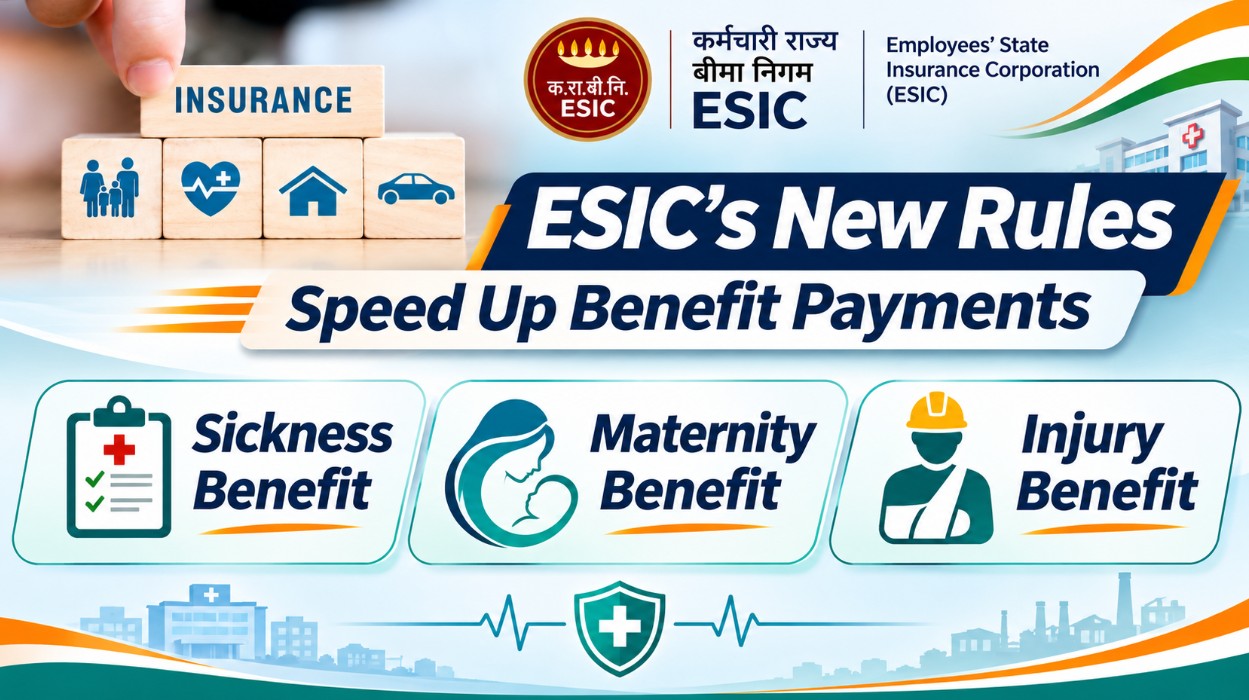
Representational Image
Under the Employees’ State Insurance (General) Regulations, 2026, eligible beneficiaries will be able to receive several cash benefits directly in their bank accounts through direct benefit transfer (DBT), without having to submit separate claim applications.
The new framework replaces the Employees’ State Insurance (General) Regulations, 1950, and aligns the scheme’s administrative procedures with the Code on Social Security, 2020.
Automatic processing of sickness and maternity benefits
Sickness and maternity benefit claims will be processed automatically when specified conditions are fulfilled. These include the generation of a medical certificate through the ESIC information system, submission of the required monthly return by the employer through its online portal, and linking of the worker’s insurance number and bank account with Aadhaar.
The move is expected to reduce paperwork and make access to cash benefits easier for eligible insured persons.
The regulations also extend the period before the expected date of delivery during which maternity benefits can be claimed from 50 days to 56 days. For insured women with two or more surviving children, the applicable period will be up to 42 days.
Accident reports to serve as benefit claims
The revised rules introduce a significant change in the processing of employment-injury claims.
Previously, workers suffering temporary disabilities had to submit separate applications, while employees with permanent disabilities and families of deceased workers were required to apply for the first payment of benefits, even after the employer had reported the accident to ESIC.
Under the new provisions, an employer’s accident report will itself be treated as the claim for temporary and permanent disablement benefits, as well as dependants’ benefits in the event of a worker’s death, once the injury is recognised as employment-related.
This will allow ESIC to initiate payment proceedings on the basis of the accident report without waiting for a separate application.
Insured workers will, however, retain the option of submitting claims independently, either online or through other permitted means.
Safeguards against payment delays
The regulations also seek to protect workers from losing or facing delays in benefits because of an employer’s failure to submit a return or verification within the prescribed time. ESIC will be required to obtain the necessary information from the employer rather than withhold benefits solely on that ground.
In cases where a DBT transaction fails because of technical difficulties or bank-account-related issues, the corporation may use an alternative payment method, provided the reasons are recorded.
The new rules prescribe timelines for benefit disbursement. ESIC will have to release sickness benefits within seven days and the first instalment of maternity benefits within 14 days after receiving a complete claim along with the required supporting documents.
Implementation and coverage
Although the regulations have been notified, the automatic claim-processing and employment-injury provisions will not necessarily become operational immediately. The date of their commencement will be specified by ESIC Director General Ashok Kumar Singh.
The changes are expected to benefit nearly four crore insured workers and around 15 crore beneficiaries, including eligible family members entitled to medical care.
The ESIC scheme provides six broad social security benefits: medical care, sickness, maternity, disablement, dependants’ and unemployment benefits.
Coverage is mandatory for establishments employing 10 or more workers under the Code on Social Security, 2020. Employees earning up to Rs 21,000 per month are eligible, with the wage ceiling extended to Rs 25,000 for persons with disabilities.
The regulations also move several administrative processes, including employee registration, issuance of insured-person cards, submission of contribution details and benefit-claim processing, towards a more extensive electronic system.
With reduced paperwork, automatic processing in eligible cases and defined payment timelines, the revised framework is intended to make social security benefits more accessible and improve the delivery of assistance to insured workers and their families.