New Delhi, Nov 27: The National Overseas Scholarship (NOS) Scheme is widening access to international higher education for meritorious Scheduled Tribe (ST) students, offering financial assistance for postgraduate and doctoral studies at leading universities abroad.
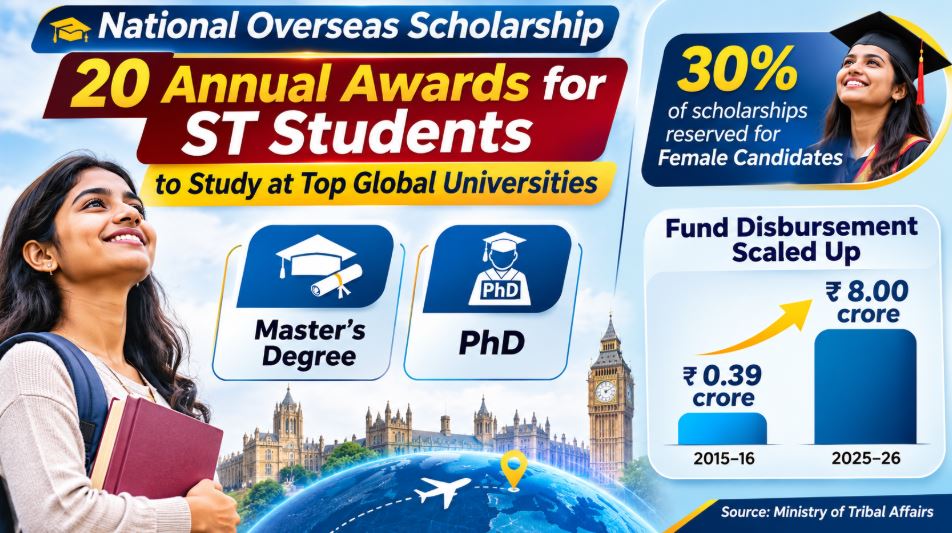
Implemented by the Ministry of Tribal Affairs, the Central Sector Scheme provides 20 fresh scholarships every year, including three earmarked for students from Particularly Vulnerable Tribal Groups (PVTGs). With 30% of the scholarships reserved for women, the programme also seeks to improve gender representation in overseas education.
From the 2026-27 academic year, the scheme supports Master's and PhD programmes at foreign universities and institutions ranked among the top 1,000 in the latest QS World University Rankings. The expansion reflects the government's effort to help tribal students access specialised education, advanced research facilities and international academic networks.
Women's participation records significant growth
The scheme's progress is reflected in the rising share of women among selected candidates. Women accounted for three of the 15 selections in 2015-16, representing 20% of beneficiaries. By 2024-25, their share had increased to 47.8%, with 11 women among 23 selected candidates.
The annual allocation of 20 fresh scholarships is distributed across four broad academic areas. Science, technology, engineering and mathematics (STEM) receive 10 slots, while management, economics, finance and law have four. Agriculture and medicine account for another four, with the remaining two allocated to humanities, social sciences and fine arts.
Of the total annual scholarships, 17 are meant for Scheduled Tribe candidates and three for PVTG students. Unfilled slots earmarked for women may be made available to eligible male applicants.
Eligibility and selection process
Applicants seeking admission to a Master's programme must have secured at least 55% marks or an equivalent grade in their relevant bachelor's degree and should not be older than 32 years as of July 1 of the selection year.
For PhD applicants, the minimum requirement is 55% marks or an equivalent grade in a relevant master's degree, with an upper age limit of 35 years as of the same date.
The scheme also sets an annual family income ceiling of ₹6 lakh. Only one child from a family can receive the scholarship, based on self-certification, and an individual can avail of the assistance only once. Candidates cannot receive another scholarship at the same or a higher level under the scheme.
Students are required to apply directly to foreign universities and subsequently seek support under NOS. Under the revised selection framework for 2026-27, priority is given to applicants who have secured admission offers from eligible institutions among the top 1,000 in the latest QS rankings but have not yet joined.
The merit list is prepared based on the ranking of the institution. If two or more applicants are tied on institutional ranking, their marks or grades in the qualifying examination will determine their relative merit.
If vacancies remain, they are filled through personal interviews conducted by an expert committee constituted by the Ministry of Tribal Affairs. Preference is given to candidates who have qualified examinations such as GRE, GMAT or TOEFL. Selected candidates must secure admission and join an eligible institution within two years of receiving the award letter.
Scholarship covers tuition, living and travel expenses
The financial assistance is designed to meet a substantial share of the costs associated with studying abroad. Students pursuing courses in the United States are eligible for an annual maintenance allowance of USD 15,400, while those studying in the United Kingdom receive GBP 9,900. Applicable allowances for other countries are provided in US dollars or at equivalent rates.
An annual contingency and equipment allowance of USD 1,532 or GBP 1,116 is also available to meet expenses such as books, essential equipment, study tours, typing and thesis binding.
The scholarship covers tuition fees and other compulsory, non-refundable institutional charges. It also provides for actual visa fees and applicable poll taxes, while medical insurance premiums are reimbursed at actual rates, subject to assessment by the concerned Indian Embassy or Mission.
Travel support includes economy-class airfare between India and the destination nearest to the educational institution, subject to the shortest route and the best available fare. Eligible local travel expenses between the arrival point and the place of study are also covered under prescribed conditions. These may include second-class rail fares or admissible bus, ferry and connecting air travel where rail services are unavailable.
The maximum period of assistance is four years for PhD programmes. For Master's courses, support is available for one or two years, depending on the duration of the programme.
Financial support and reach expand
Government disbursements under the scheme have increased substantially, rising from ₹0.39 crore in 2015-16 to ₹8 crore in 2025-26. Since 2014-15, the Ministry of Tribal Affairs has released a total of ₹46.46 crore under the programme.
The number of students receiving support, including new and continuing beneficiaries, increased from eight in 2013-14 to 64 in 2025-26. In all, 400 students received assistance over the period covered by the government's figures.
The scheme is open to eligible ST students across all States and Union Territories. Scholarships and funds are not distributed through fixed state-wise or district-wise quotas, allowing eligible candidates from any part of the country to compete under the prescribed criteria.
The initiative comes amid an increase in Scheduled Tribe participation in higher education. According to the All India Survey on Higher Education (AISHE) 2023-24, ST enrolment reached 28,83,218, compared with 21,56,109 in 2019-20.
Online portal facilitates applications
Applications are invited through the dedicated National Overseas Scholarship Portal, which provides scheme guidelines, application instructions and details of required documents.
Integrated with DigiLocker, the portal allows applicants to retrieve available documents digitally and upload additional records. It also provides facilities for submitting queries and grievances, while automated SMS and email alerts keep registered candidates informed about application-related updates. A dashboard supports monitoring and administration of the scheme.
The programme is implemented through Indian Embassies and Missions abroad under the Ministry of External Affairs.
By combining international academic access with financial assistance, the National Overseas Scholarship Scheme aims to reduce economic barriers that may prevent talented tribal students from pursuing advanced education overseas. Its focus on PVTGs and women's participation also seeks to make these opportunities more inclusive, while enabling beneficiaries to acquire knowledge and skills that can contribute to their communities and the country's development.