From Sacred Waters to Distant Shores: The Sadhabas, Their Voyages and a Civilisation's Living Legacy
Introduction: When History Sets Sail
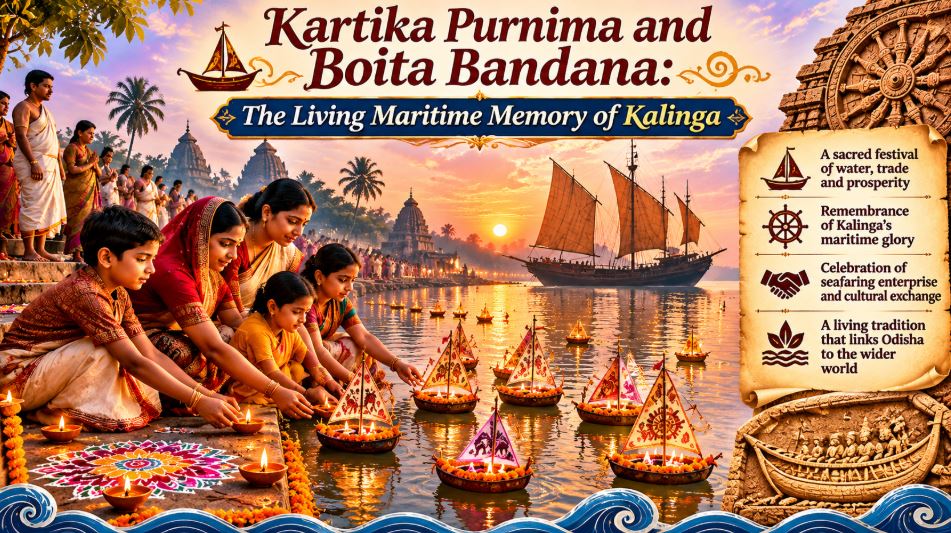
Every year, on the full-moon day of Kartika, the waters of Odisha become a living canvas of history, faith and collective memory. At dawn, thousands gather beside rivers, ponds, lakes and coastal stretches to float miniature boats carrying lamps, flowers, betel leaves and areca nuts. The ritual, known as Boita Bandana, is more than a religious observance. It is a symbolic remembrance of the maritime voyages undertaken by the merchant seafarers of ancient Kalinga, popularly known as the Sadhabas.
Closely associated with this tradition are Kartika Purnima, the culmination of a month of spiritual discipline, and the figure of the Sadhaba Pua, the son of a merchant-seafarer, who represents the generational and familial dimension of Odisha's maritime heritage.
Together, these traditions reveal an extraordinary cultural synthesis in which religious devotion meets commercial history, seasonal ecology intersects with maritime knowledge, and collective memory preserves the experiences of generations.
Odisha's maritime heritage is therefore not merely a story of ancient ships and overseas trade. It is also a story of families, women, children, faith, separation, enterprise and cultural exchange. The miniature boat that floats on Kartika Purnima carries within it the memory of a civilisation that once looked towards the sea as a gateway to opportunity and the wider world.
1. Kartika Purnima: The Sacred Journey from Restraint to Renewal
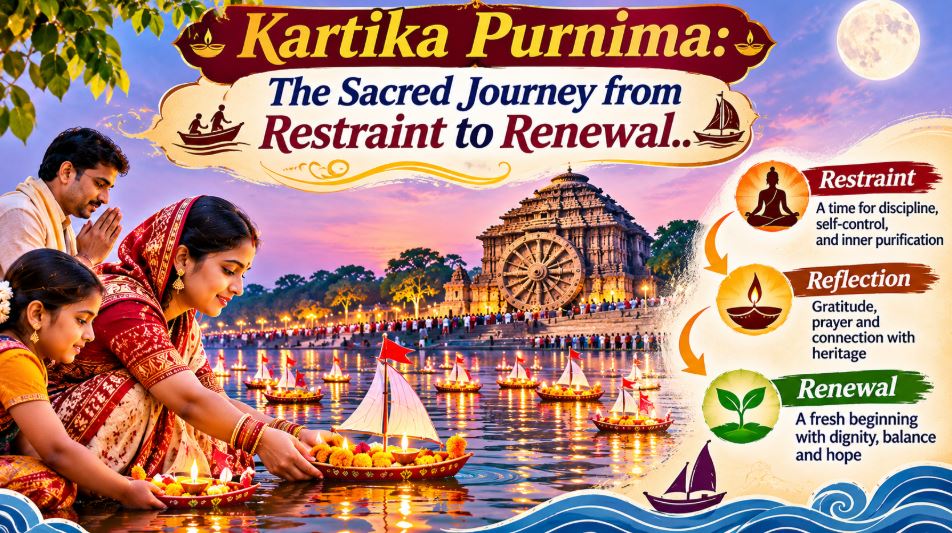
Kartika occupies a special place in Odisha's religious and cultural calendar. Traditionally regarded as a spiritually auspicious month, it is associated with devotion, purification, self-discipline and restraint.
Many devotees observe early-morning bathing, prayer, worship and dietary restrictions. Those undertaking Habisha follow a disciplined vegetarian diet, while abstention from non-vegetarian food is widely practised during the month. The final five days, known as Panchuka, carry particular religious significance, with intensified devotional observances across households and temples.
The culmination of this sacred period on Kartika Purnima is especially meaningful. The full moon symbolises completeness, illumination and spiritual fulfilment. Yet, in Odisha, the occasion extends beyond conventional religious observance.
Representational Image
It becomes a moment when inward spiritual discipline opens into outward collective celebration.
There is a fascinating relationship between the austerity of Kartika and the maritime symbolism of Boita Bandana. A month devoted to restraint, purification and spiritual reflection concludes with a ritual celebrating movement, enterprise and the historical connections of Kalinga with distant lands.
This is not a contradiction between religion and commerce. Rather, it reflects the capacity of Odia culture to accommodate different dimensions of human experience within a shared sacred calendar.
Water provides the connecting element. During Kartika, bathing in sacred waters represents purification. On Kartika Purnima, those same waters become symbolic pathways through which the memory of ancient maritime journeys is renewed.
Thus, Kartika Purnima brings together the spiritual geography of Odisha and its historical relationship with the sea.
2. Boita Bandana: A Small Boat Carrying a Great Civilisation
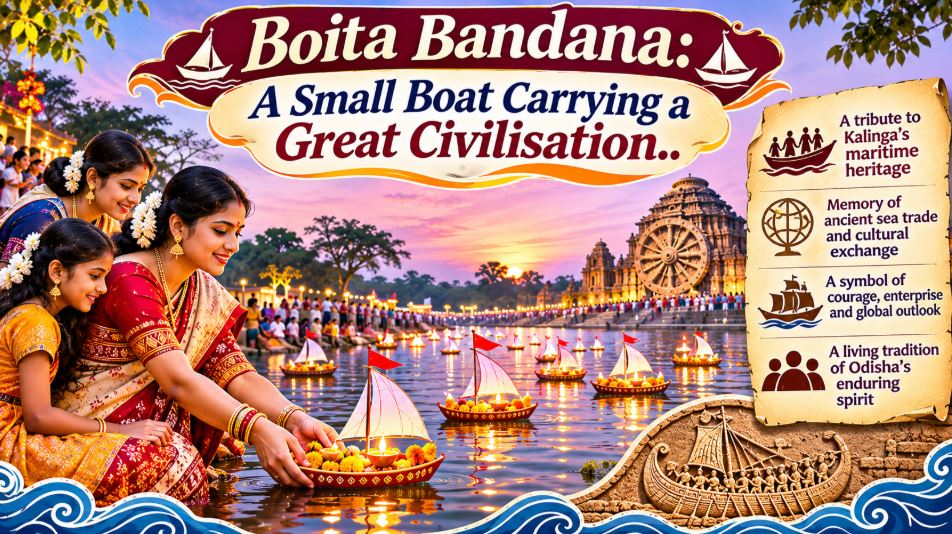
Boita Bandana, meaning the veneration or worship of the boat, is one of Odisha's most distinctive cultural traditions.
On the morning of Kartika Purnima, families, particularly women and children, gather beside water bodies and float miniature boats made traditionally from banana stems, bark, cork, sola pith and other locally available materials. Contemporary versions may also use paper and decorative materials.
The boats are decorated with flowers, lamps and traditional offerings, including betel leaves and areca nuts. As they move across the water, participants recall the voyages of the Sadhabas and the maritime traditions of ancient Kalinga.
Representational Image
The ritual is often accompanied by the familiar Odia chant:
“Aa Ka Ma Bai, Pana Gua Thoi.”
Popular interpretations associate the syllables with the traditional sailing calendar and seasonal months such as Ashadha, Kartika, Margashira and Baisakha. The precise historical and linguistic derivation of the chant, however, requires cautious interpretation.
Its cultural significance is nevertheless unmistakable. It preserves an association between seasonal rhythms, maritime departures and the commercial activities of traditional seafaring communities.
The post-monsoon period was historically important for navigation in the Bay of Bengal. Knowledge of seasonal winds, currents, tides and coastal conditions played a vital role in determining maritime movements.
Boita Bandana symbolically recalls this relationship between human enterprise and the natural environment.
The miniature boat and the memory of the ocean
Perhaps the most remarkable feature of the ritual is its simplicity.
A small boat made from humble materials represents the large vessels that once carried merchants across the Bay of Bengal. A tiny flame recalls the hopes and uncertainties of distant voyages. A local pond becomes a symbolic extension of the ocean.
This transformation gives Boita Bandana its deeper cultural meaning.
It does not attempt to reconstruct ancient ships or reproduce historical voyages literally. Instead, it compresses an extensive maritime history into a simple household ritual.
Through this act, the distance between ancient Kalinga and contemporary Odisha is symbolically reduced. Every participant becomes a custodian of maritime memory, even without possessing detailed knowledge of ancient ports, trading networks or navigational practices.
The boat may be small, but the history it represents is immense.
3. Kalinga's Maritime World: From the Bay of Bengal to Southeast Asia
The maritime history of ancient Kalinga forms an important part of the wider history of the Bay of Bengal.
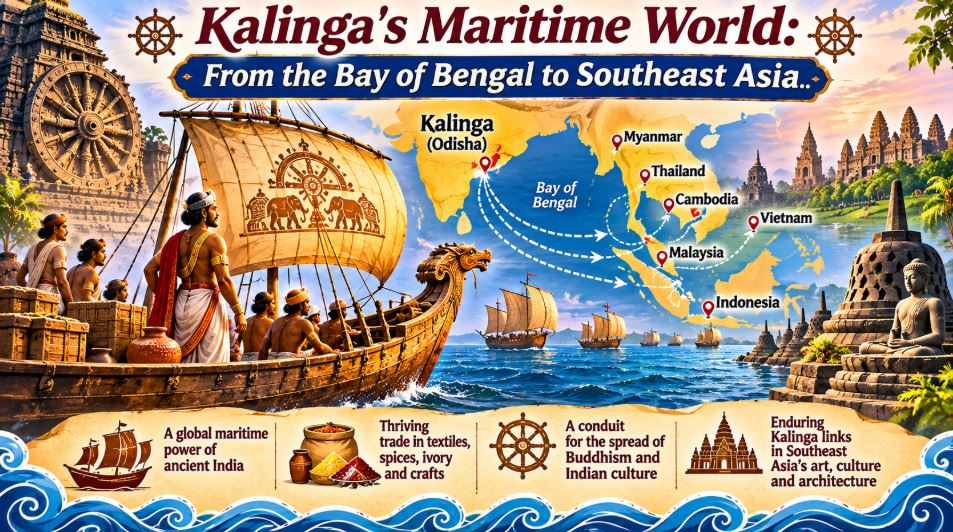
The geographical position of the eastern Indian coast, together with its river systems and coastal settlements, facilitated commercial contact with Sri Lanka and maritime Southeast Asia.
Historical and archaeological evidence points to long-standing interactions between eastern India and regions associated with present-day Myanmar, Thailand, the Malay Peninsula, Indonesia and other parts of the Indian Ocean world.
Merchant communities participated in networks that carried textiles, spices, precious materials and other commodities. Alongside commercial exchange travelled religious ideas, artistic influences, technologies and cultural practices.
Representational Image
These connections were not merely economic. They contributed to a wider process of cultural interaction through which societies across the Bay of Bengal became connected.
The maritime history of Kalinga should therefore be understood as part of a larger Asian network of trade and exchange rather than as an isolated regional achievement.
Popular Odia maritime memory particularly associates these voyages with Bali, Java and Sumatra. Bali Jatra, the celebrated annual fair of Cuttack, preserves this geographical and cultural imagination.
The fair is a reminder of Odisha's historical engagement with the maritime world and its longstanding association with overseas commercial exchange.
It is important, however, to distinguish historical evidence from popular narratives. The precise routes, chronology and scale of individual voyages cannot be established solely through contemporary festival traditions. Nevertheless, the broader maritime connections of ancient Kalinga form an important subject of historical and archaeological study.
What Boita Bandana preserves is the enduring cultural memory of this wider maritime experience.
4. The Sadhaba Pua: The Human Face of Maritime History
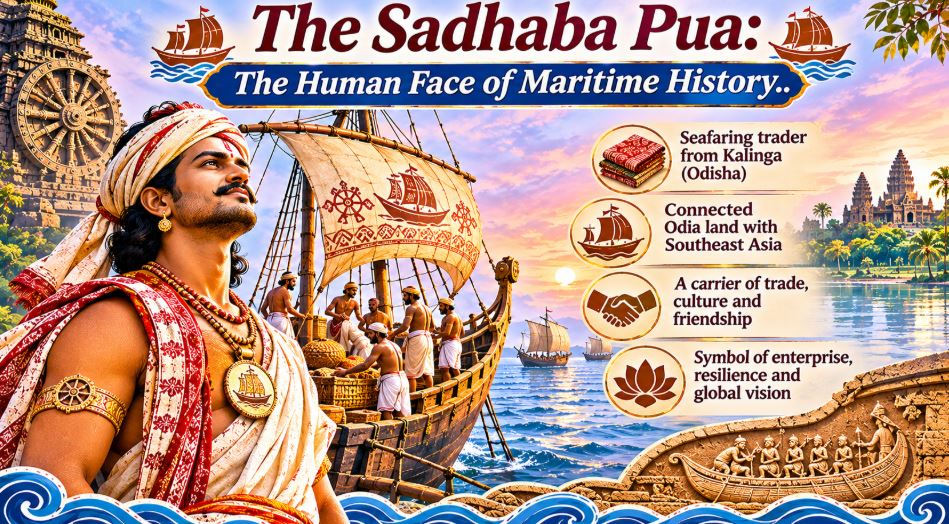
The Sadhaba represents the merchant-seafarer of ancient Kalinga, associated with overseas trade, commercial enterprise and maritime mobility.
The Sadhaba Pua, literally the son of a Sadhaba, introduces a deeply human dimension into this historical narrative.
He represents not only the descendant of a merchant family but also the continuity of maritime identity across generations. His figure evokes the transmission of commercial knowledge, family expectations, social responsibilities and the aspirations associated with seafaring life.
Yet the story of a maritime voyage does not begin and end with the departure of a ship.
Representational Image
Behind every departing vessel was a household. Parents, wives, children and other family members remained behind, often facing prolonged separation and uncertainty about the safe return of their loved ones.
This domestic world is an essential but frequently overlooked dimension of maritime history.
The Sadhaba Pua therefore represents more than commercial inheritance. He symbolises the relationship between outward mobility and the emotional world of the family.
His departure could mean prosperity and opportunity, but it could also mean anxiety, longing and an uncertain future for those who remained at home.
5. Taapoi and the Forgotten Voices of Maritime Memory
Odia folk traditions provide a valuable perspective on the emotional consequences of maritime mobility.
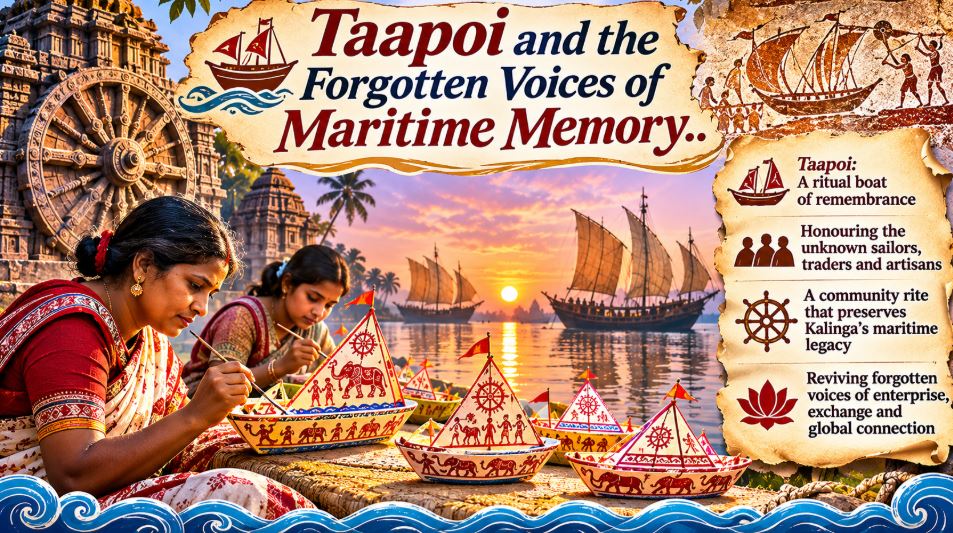
One particularly significant example is the story of Taapoi, which is deeply embedded in regional folk memory and associated with the observance of Khudurukuni Osha.
The narrative is commonly associated with a merchant family whose brothers undertake overseas voyages, leaving their sister behind. Its emotional focus is on the vulnerability of the young girl, familial neglect and the longing for the return and support of her brothers.
Although Taapoi belongs to a different ritual and narrative context from Boita Bandana, the two traditions illuminate complementary aspects of maritime life.
Boita Bandana symbolically remembers the departing vessel. Taapoi brings attention to the household left behind.
One celebrates the outward movement of enterprise; the other recalls the emotional consequences of separation.
This relationship is particularly important from a gender perspective.
Representational Image
Conventional histories of maritime trade tend to focus on merchants, sailors, ships, commodities and overseas destinations. Folk narratives, however, reveal the experiences of women and children whose lives were shaped by the absence of those who travelled.
Women were not merely passive observers of maritime activity. Through household rituals, prayers, folk narratives and the transmission of cultural traditions, they played an important role in preserving maritime memory.
Their participation in Boita Bandana continues this role. By preparing miniature boats and passing the ritual to younger generations, they sustain the cultural connection between Odisha's domestic world and its maritime past.
The Sadhaba's voyage, therefore, must also be understood through the lives of those who waited for his return.
6. The Sea, the Seasons and Ecological Knowledge
Another important dimension of Boita Bandana is its relationship with the natural environment.
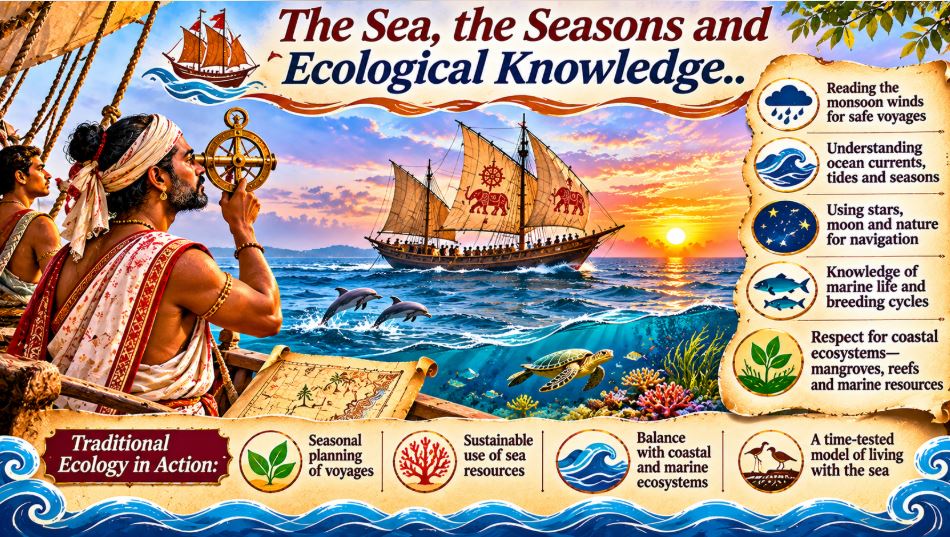
Traditional maritime communities depended upon a close understanding of seasonal weather, monsoon winds, tidal movements, coastal geography and river systems.
Navigation was not simply a matter of building a vessel and setting sail. It required accumulated knowledge of natural conditions and the ability to adapt to changing environmental circumstances.
The seasonal associations of Kartika Purnima preserve a cultural memory of this relationship.
The post-monsoon period was important in the historical navigation calendar of the Bay of Bengal. The timing of voyages was influenced by the changing conditions of the sea and the availability of favourable winds.
Representational Image
Boita Bandana transforms this practical environmental knowledge into a symbolic cultural expression.
It also reminds contemporary society of the importance of water bodies in Odisha's ecological and cultural life.
However, modern celebrations sometimes introduce plastic decorations and thermocol materials that can pollute rivers, ponds and lakes.
This is an important contradiction that deserves attention.
The traditional use of biodegradable materials such as banana stems and other natural resources offers a more environmentally responsible model. Reviving these practices would strengthen the ecological meaning of the festival.
A celebration that honours the sea and rivers should also protect them.
7. Bali Jatra: When Maritime Memory Becomes Public Celebration
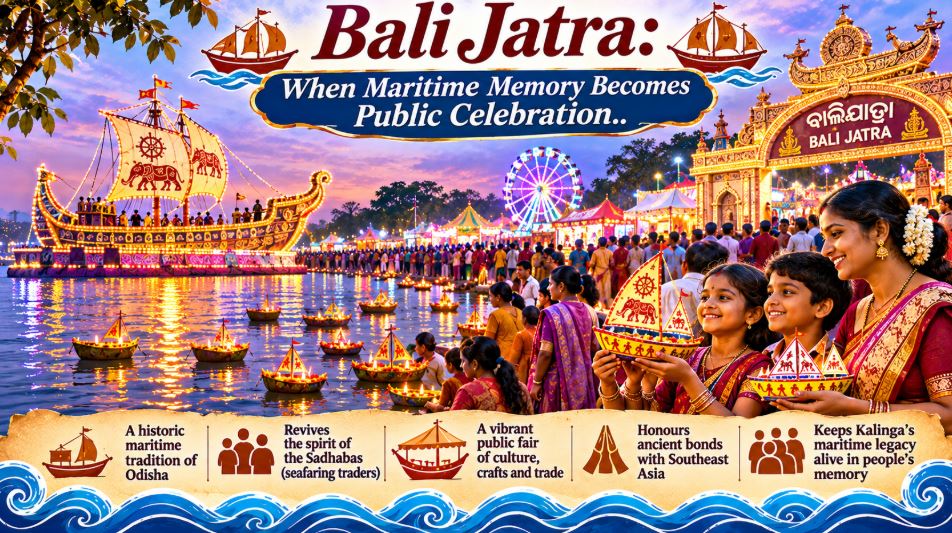
If Boita Bandana represents maritime memory at the household level, Bali Jatra expands that memory into the public sphere.
The annual fair in Cuttack is one of Odisha's most prominent cultural celebrations. It brings together commerce, handicrafts, food, entertainment, cultural performances and public participation.
Its significance extends beyond the scale of the event. Bali Jatra transforms historical memory into a contemporary experience.
The ancient association between merchants and overseas trade is reflected in a modern celebration of enterprise, craftsmanship and economic activity.
Representational Image
There is also an interesting symbolic connection between the Sadhaba of the past and the entrepreneur of the present.
The historical merchant travelled across seas to establish commercial relationships. The contemporary entrepreneur engages with markets shaped by modern transportation, technology and international trade.
The circumstances are different, but the underlying themes of enterprise, exchange and outward engagement remain relevant.
Bali Jatra thus serves as a cultural bridge between historical maritime identity and Odisha's contemporary aspirations.
8. The Living Legacy: Why These Traditions Matter Today
Kartika Purnima, Boita Bandana and the Sadhaba Pua endure because they are not dependent exclusively on the survival of ancient maritime institutions.
Their continuity rests on the ability of communities to reinterpret and transmit historical memory through everyday cultural practices.
They offer several important lessons for contemporary Odisha.
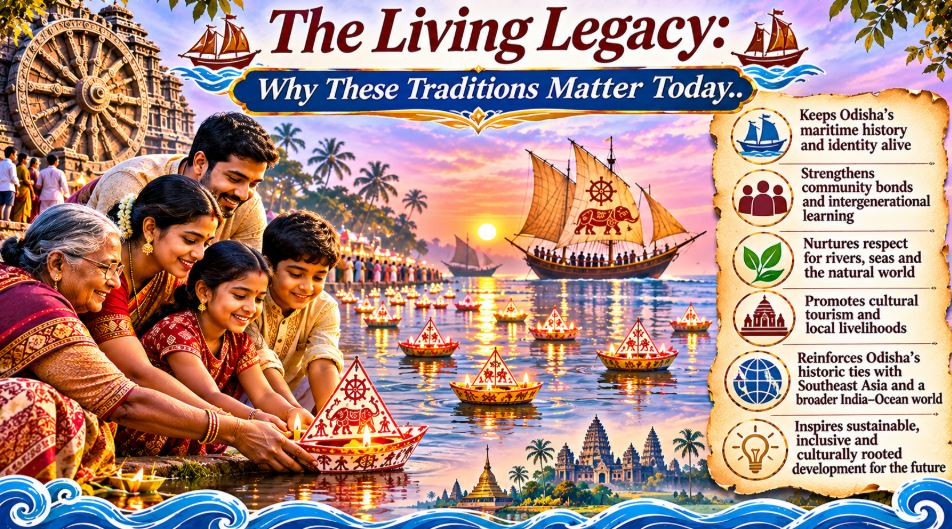
First, they encourage a deeper understanding of the state's maritime history and its historical connections with Southeast Asia.
Second, they provide opportunities for cultural diplomacy and regional cooperation across the Bay of Bengal.
Representational Image
Third, they highlight the importance of preserving folk traditions and recognising women's contributions to the transmission of cultural memory.
Fourth, they offer a platform for connecting historical maritime knowledge with contemporary concerns such as coastal conservation, river protection and sustainable development.
Finally, they remind society that maritime heritage is not merely about the past. It is also about the ability to look outward, engage with other cultures and participate confidently in a wider world.
Odisha's maritime identity should therefore be preserved not simply as nostalgia but as an intellectual, cultural and economic resource for future generations.
Conclusion: The Voyage Never Ends
Kartika Purnima represents sacred devotion. Boita Bandana embodies the memory of maritime journeys. The Sadhaba Pua gives this memory a human and generational identity. Together, they connect faith, commerce, ecology, family and history in a remarkable expression of Odisha's cultural civilisation.
The ancient merchant ships may have disappeared, and the trading networks of earlier centuries may have transformed, but the memory of those voyages continues to sail through the collective imagination of the people.
Every year, when a miniature boat carrying a flickering lamp is released into the water, Odisha renews its connection with the maritime world of ancient Kalinga.
It is a moment when history becomes ritual, geography becomes memory and a simple household gesture acquires civilisational significance.
The boats may be miniature, but the civilisation they represent is immense. And as long as these little boats continue to sail on Kartika Purnima, the maritime spirit of Kalinga will never fade.