New Delhi, Nov 23: India has called for greater international cooperation to preserve, digitise and promote the rich manuscript heritage shared across the Shanghai Cooperation Organisation (SCO) region, as scholars and delegates from member countries explored ways to reconnect centuries-old knowledge traditions.
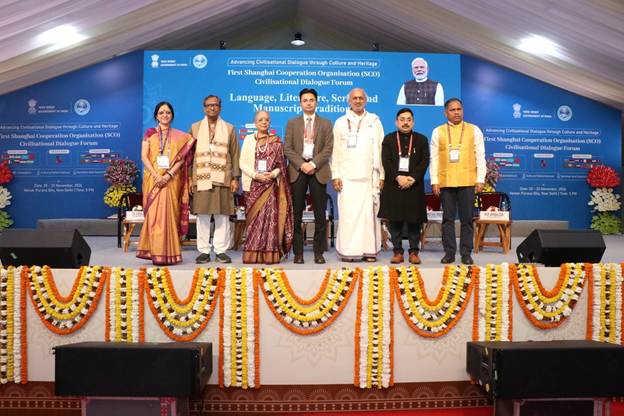
The discussions took place during a session on “Language, Literature, Script and Manuscript Traditions”, organised by the Ministry of Culture under the Gyan Bharatam Mission on November 22 at Purana Qila in New Delhi. The session was part of the first SCO Civilization Dialogue Forum, held from November 20 to 22.
The deliberations focused on the movement of knowledge across borders through languages, scripts, literature and manuscripts, while highlighting the need to make historical records more accessible through modern technology and collaborative research.
Gyan Bharatam highlights digital preservation efforts
Inderjeet Singh, CEO of Gyan Bharatam and Joint Secretary in the Ministry of Culture, briefed international delegates on the mission's key activities, including manuscript surveys and cataloguing, conservation, capacity building, digitisation, linguistic research, translation, publication and outreach.
He said more than 1.26 crore manuscripts had been reported through the National Manuscript Survey, marking a significant milestone in documenting India's manuscript resources.
Singh also outlined technology-driven initiatives associated with the mission, including Gyan-Mitram AI, Pandulipi Darpana and BharatiyaGPT. He emphasised the importance of Indic scripts across the SCO region and called for collective efforts to build a global digital repository of knowledge.
Describing international collaboration as central to the mission, he said the initiative represented both a responsibility and an invitation to work together.
The session was moderated by Prof. Anirban Dash, Project Director of Gyan Bharatam, who highlighted how languages and literature preserve ideas while manuscripts carry knowledge across generations and geographical boundaries.
Scholars discuss language, translation and technology
The discussions were organised around four themes: India's linguistic and script heritage and its influence on Asian languages; the transmission and translation of Indian literature across Asia; the global presence of India's dispersed manuscript collections; and the role of digital technology in reconnecting fragmented knowledge resources.
Prof. Rajnish Kumar Mishra of Jawaharlal Nehru University spoke about India's diverse linguistic and script traditions and their influence beyond the country's borders. He discussed the movement of Indian cultural and intellectual traditions through historical networks, including the Silk Route, and referred to prominent scholars and regional manuscript traditions.
Prof. K.K. Mishra of the University of Calcutta stressed the need to expand digitisation, translate manuscripts into more languages and use artificial intelligence to improve global access. He also highlighted the importance of international archival partnerships and institutional cooperation.
Dr. Viswajanani J. Sattigeri, Head of the Traditional Knowledge Digital Library (TKDL) Unit, underlined the need to safeguard traditional knowledge from misuse and misappropriation. She discussed intellectual property protection, patent-related information and structured metadata, emphasising the importance of controlled digital access.
Prof. K. Rama Subramaniyam of IIT Bombay highlighted the role of manuscripts in understanding knowledge systems and interpreting historical ideas. Referring to the Panchatantra, which has been translated into more than 50 foreign languages, he stressed the importance of accurate and unbiased translations.
He also observed that preserving a manuscript means safeguarding not just its written content but also the history, cultural practices and traditions associated with it.
SCO countries express interest in collaboration
Delegates from Iran, Kyrgyzstan, Pakistan, Cambodia, Uzbekistan, Laos and Nepal participated in the exchange, sharing their respective initiatives and experiences in manuscript conservation.
Several delegates expressed interest in working with the Gyan Bharatam Mission and the Ministry of Culture on projects related to manuscript preservation and research.
The session concluded with a collective emphasis on expanding cooperation in manuscript conservation, script training, comparative literary studies, translation, cataloguing, academic exchanges and joint research.
The discussions reaffirmed the potential of shared historical knowledge and cultural heritage to deepen understanding and strengthen ties among countries across the SCO region.