Roorkee, Aug 4: As countries around the world seek cleaner alternatives to conventional chemical manufacturing, researchers at the Indian Institute of Technology Roorkee have developed a sustainable catalytic method that converts renewable alcohols into complex organic molecules, important building blocks used in pharmaceuticals and advanced organic materials. Published in Nature Communications, the study contributes to advances in green chemistry by demonstrating how renewable feedstocks and an earth-abundant nickel catalyst can enable highly selective chemical synthesis.
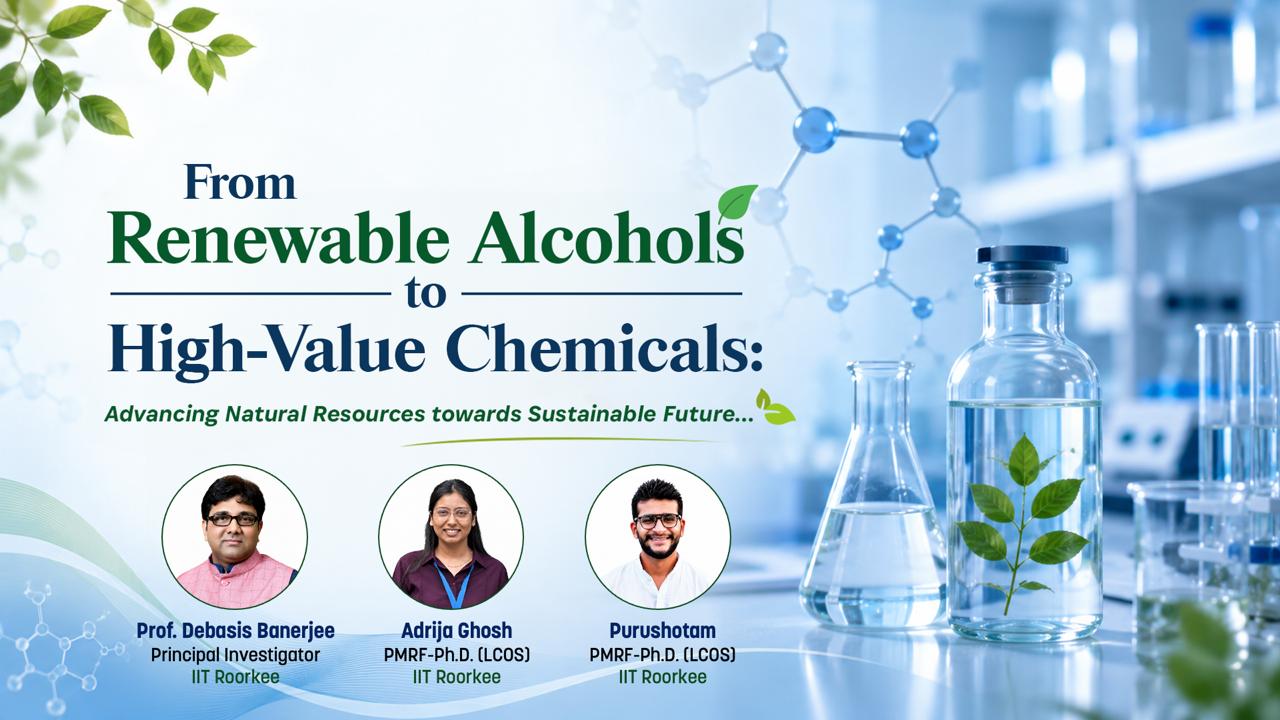
The study, led by Prof. Debasis Banerjee from the Department of Chemistry, IIT Roorkee, demonstrates a ligand-enabled nickel catalytic process that efficiently converts biomass-derived alcohols into trisubstituted olefins and 1,3-dienes, two classes of industrially important building blocks used in the development of pharmaceuticals and advanced organic materials.
Conventional synthesis often requires multiple reaction steps and expensive catalysts. The IIT Roorkee-led research introduces a modular and efficient catalytic approach using a commercially available, earth-abundant nickel catalyst, enabling high stereoselectivity while utilizing renewable alcohols as sustainable feedstocks.
The process successfully produced 27 trisubstituted olefins with stereoselectivities of up to 98:2 and 23 highly selective 1,3-dienes . The researchers also demonstrated the versatility of the methodology through the late-stage functionalization of biologically relevant molecules such as DL-galactose and α-tocopherol , as well as the synthesis of a tamoxifen analogue and polyaromatic hydrocarbons, highlighting its broad applicability in medicinal and materials chemistry.
The researchers also uncovered how the catalytic reaction proceeds at the molecular level, providing valuable mechanistic insights that could guide the design of future sustainable catalytic systems.
Commenting on the achievement, Prof. K. K. Pant, Director, IIT Roorkee, said,
" Fundamental research in chemistry plays a vital role in enabling cleaner and more sustainable technologies. This publication in Nature Communications reflects IIT Roorkee's commitment to advancing high-quality research that addresses global scientific challenges while contributing to the future of sustainable chemical synthesis."
Explaining the significance of the research, Prof. Debasis Banerjee, Department of Chemistry, IIT Roorkee, said,
"Our objective was to develop a catalytic platform that converts readily available renewable alcohols into structurally complex and industrially valuable molecules with high selectivity using an earth-abundant metal catalyst. Beyond developing an efficient synthetic method, our study provides mechanistic insights that can guide the design of future catalytic reactions using renewable feedstocks.”
The research aligns with the global transition toward green chemistry, where renewable feedstocks, energy-efficient catalytic processes, and reduced chemical waste are becoming increasingly important. By utilizing biomass-derived alcohols as renewable feedstocks and employing nickel, an earth-abundant and economical metal, in place of precious-metal catalysts, the work advances environmentally responsible chemical synthesis while supporting the principles of sustainable manufacturing.
The study was carried out by Adrija Ghosh and Purushotam from IIT Roorkee, in collaboration with Prof. Chao-Jun Li of McGill University, Canada. The research was supported by the Ministry of Education's STARS Programme and the Anusandhan National Research Foundation, Government of India, while the student researchers received support through the Prime Minister's Research Fellowship , reflecting India's continued investment in high-quality fundamental research.
As industries worldwide seek cleaner and more resource-efficient manufacturing technologies, this study expands the toolkit of sustainable synthetic chemistry. The methodology provides researchers with a new strategy for synthesizing complex organic molecules from renewable resources and is expected to inspire further advances in catalytic chemistry based on renewable feedstocks.