Delhi, Nov 02: NovAtom Labs, a student-led deeptech startup founded by Arnav Kulshreshtha and Sattwik Das at BITS Pilani, Hyderabad Campus, is building AI technology designed to function as an intelligence layer for scientific research. “Research copilot” intends to help researchers understand complex research problems, synthesise scientific literature, identify relevant parameters and constraints, learn from previous experimental or computational results, and explore potential directions for further investigation.
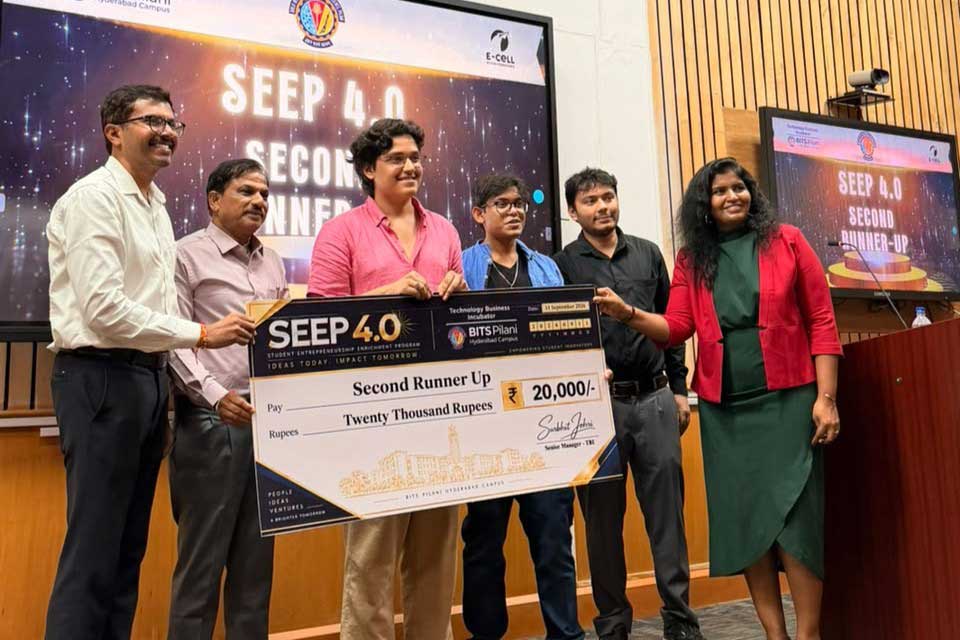
What began as an initiative developed from hostel rooms, alongside freelance AI projects and independent research, has evolved into a platform being explored by researchers and scientific institutions in India and internationally.
The technology developed by NovAtom Labs has been used and evaluated by researchers associated with institutions including ETH Zurich, Georgia Institute of Technology, and the University of Toronto.
In India, the platform has been demonstrated to researchers and engineers at the Semiconductor Laboratory, Mohali, where NovAtom Labs is now collaborating on the application of its technology to semiconductor research problems.
The platform has also been used and explored by researchers at BITS Pilani, Hyderabad Campus, including researchers working across areas such as semiconductor technology, materials research, biology and engineering.
The development reflects the growing role of interdisciplinary AI systems in scientific research, where researchers must often navigate large bodies of scientific literature while simultaneously considering experimental constraints, computational results and physical parameters.
NovAtom Labs' technology is being developed around a broader research workflow:
1.Understand the research problem
2.Explore existing knowledge
3.Identify promising directions
4.Conduct experiments or simulations
5.Learn from the results
6.Determine what to investigate next
Rather than positioning AI solely as a system for retrieving information or generating text, the founders aim to develop technology that can support researchers throughout this iterative discovery process.
Such systems could have applications across areas including semiconductors, materials science, chemistry, biology, biotechnology, pharmaceuticals, energy and advanced manufacturing, where researchers frequently need to explore large spaces of possible materials, processes, experimental conditions or scientific hypotheses.
For the founders, the project represents an effort to build advanced scientific and technological infrastructure from India.
Arnav Kulshreshtha and Sattwik Das began developing the technology while working on AI projects independently. Their early efforts involved reaching out to researchers and institutions to understand how AI could be applied to real-world scientific problems.
Speaking about their long-term vision for NovAtom Labs, the co-founders said,
“We aim to develop self-driving research laboratories in India. This will help create a research environment where AI systems can work alongside scientists to analyse knowledge, design and prioritise experiments, learn from experimental outcomes, and continuously help determine the next direction for research.”
The founders see this as part of a broader transition in scientific research, where AI can increasingly serve not merely as a tool for accessing information, but as an intelligent layer connecting scientific knowledge, experimentation, computation and decision-making.
The development of NovAtom Labs demonstrates how student-led innovation can emerge from academic environments and progress toward applications in advanced research.
Beginning with experiments and AI projects undertaken by two students, the platform has progressed to engagements with researchers across multiple scientific disciplines and collaborations involving semiconductor research.