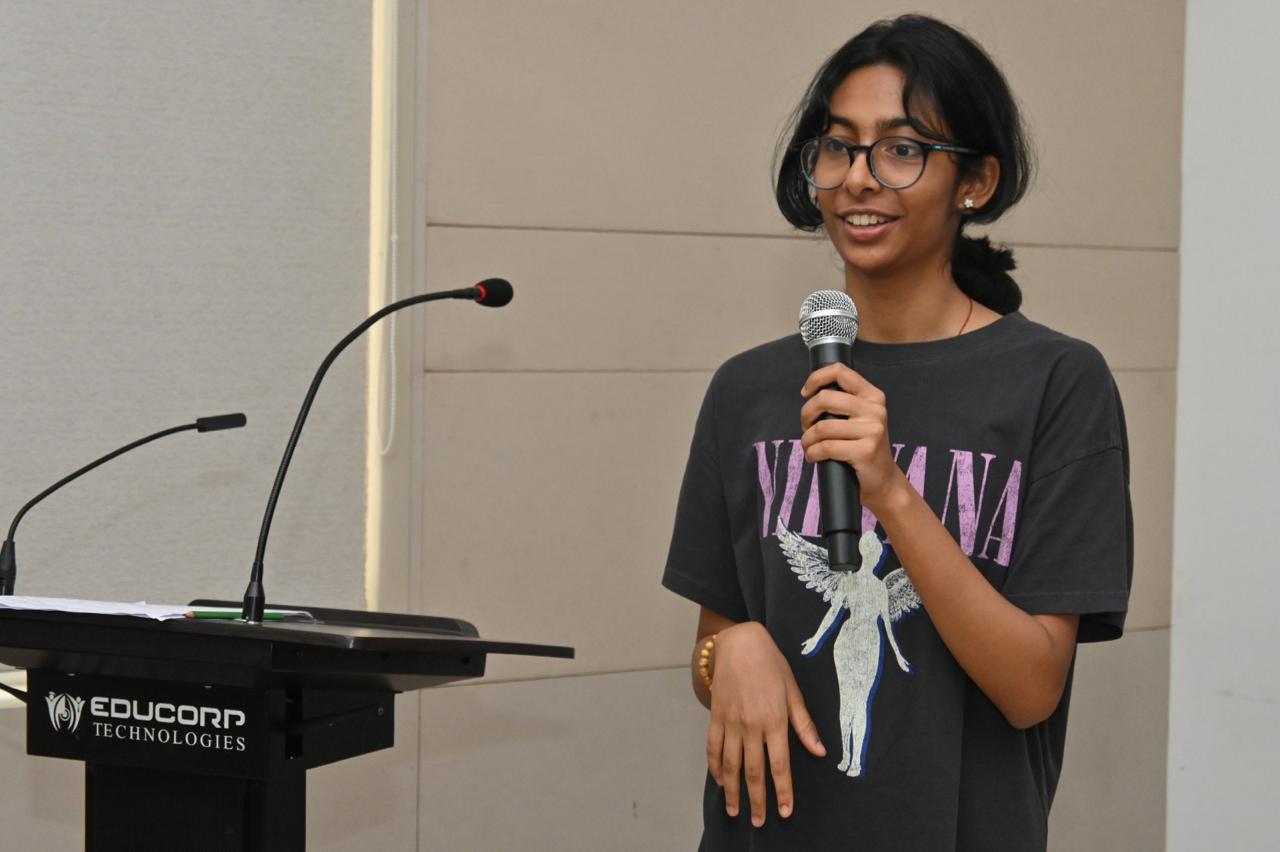
Shruti, a student of Sishya School, set out to explore whether structured art activities could help children express themselves and build aspects of wellbeing. She went on to design a five-activity, mindfulness-based art programme, Art for Wellbeing, and tested it in two very different settings: first at a school for neurodiverse children in Chennai, and then in a rural mainstream classroom at Swami Dayananda School, Manjakkudi, a village roughly six hours from the city.
In Manjakkudi, the programme ran for five weeks, with twice-weekly sessions involving 100 children. Shruti developed bilingual Tamil-English evaluation materials, trained the school's teachers, and the teachers delivered the programme independently.
Pre- and post-programme assessments recorded an increase in average scores across all five wellbeing domains measured. Teachers also reported classroom changes they observed first-hand, including greater focus, patience and collaboration. They noted that some children who were less comfortable expressing themselves in words were able to communicate more readily through art.
Art for Wellbeing is now moving into its next phase of expansion. Shruti is developing structured teacher-training resources so that schools can adopt the programme without her being physically present, and she is in discussions with additional rural schools about extending it further. The programme is also being piloted at Kripa Care in Chennai to evaluate its potential benefits for autistic adults and a geriatric population, exploring how structured art and mindfulness activities can be adapted for different ages and needs.
Art for Wellbeing is not positioned as clinical art therapy. It is a structured, accessible set of art and mindfulness activities that teachers and caregivers can use to support wellbeing and expression. The project brings together student research, field implementation, teacher training and outcome measurement, and is now entering its next phase of expansion.