Gandhinagar, Oct 30: What happens when a tennis ball is placed on top of a basketball, and both are dropped together? How many doors remain open after 100 people successively toggle the state of 100 doors? And what if a sequence of numbers follows a pattern that has little to do with a mathematical formula?
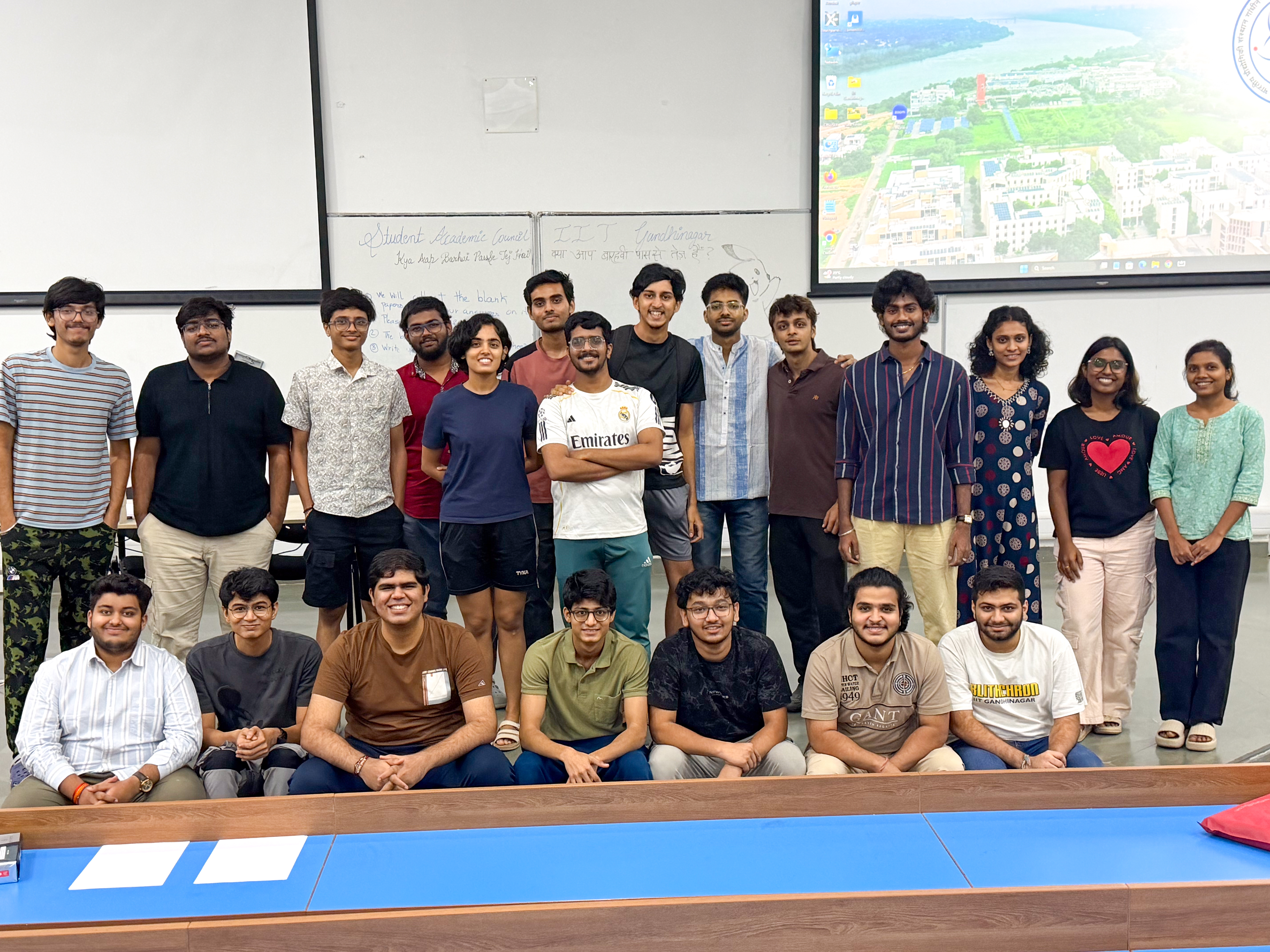
These questions were posed during the 9th edition of Kya Aap Barhvi Paas Se Tez Hai?, a quiz held this month at the Indian Institute of Technology Gandhinagar. The name, which roughly translates to ‘Are You Smarter Than a Class 12 Student?’, is a nod to Kya Aap Paanchvi Pass Se Tez Hai?, the 2008 television show in which Shah Rukh Khan pitted adults against primary-school questions. At IITGN, the contestants had already cleared one of the country’s toughest entrance examinations. The quiz asked whether the habits that got them there would help them or get in the way.
Organised by IITGN’s Student Academic Council, the quiz was started in 2016 by Harsh Gupta, then a BTech student and the council’s Academic Secretary. This year’s edition ran in two rounds: an online round on October 10, open to the entire student body, and an on-campus round on October 13. In the final, 32 students in eight teams of four competed. They were drawn from every year of the BTech programme, along with a group of first-year MSc Cognitive Science students.
For these students who have spent years preparing for competitive examinations such as the Joint Entrance Examination, rigorous mental training develops accuracy, speed, and the ability to recognise familiar problem types and apply the right method quickly. The quiz sought to create space for the kind of intellectual exploration that helps students recognise when their first approach is inadequate. This is an important part of learning, particularly in fields where problems rarely present themselves in the same form as textbook examples.
For Akshat Shah, a second-year BTech student in Electrical Engineering and a member of SAC, the quiz was a refreshing break from the years of examination preparation that preceded his entry into IITGN. “The quiz introduced me to the spirit of IITGN as a fresher. The focus was not solving numericals, but asking the right questions, trusting our reasoning, and being willing to rethink our answers,” he said.
A broader aim of the event was to foster a campus culture where intellectual rigour and playful exploration go hand in hand. According to Aditya Prachand, Academic Secretary of SAC and one of the organisers, “Through Kya Aap Barhvi Paas Se Tez Hai?, we wanted to create a space where students could challenge their thinking in unconventional ways and rediscover the joy of learning out of curiosity rather than compulsion,” he said.
The distinction between knowing a method and questioning its suitability also emerged in the participants’ experiences. Nupoor Assudani, a fourth-year BTech student in Computer Science and Engineering, recalls a question involving a sequence of numbers. Her first instinct was to search for a mathematical formula, but the answer depended on how the digits were arranged. The experience, she said, taught her to question her assumptions and move beyond a standard approach.
Such moments illustrate how problem-solving is not always about applying more knowledge or using a more complicated technique. This does not diminish the importance of formal instruction or assessment, according to Prof Bhaskar Datta, Dean of Academics at IITGN. “Such student-led intellectual activities are a useful complement to coursework and assessments. They encourage students to take ownership of learning, think critically, ask questions, and learn from one another. They also create opportunities for curiosity and collaboration beyond the classroom,” he said.
The competition was won by Team ezpz, made up of final-year BTech students. Team Girl Gang, from the third year, came second, and Hasan & Co., also in their final year, finished third.
None of it counted towards a grade. But for students who have spent years training to find the right answer fast, the quiz offered practice in something engineering will ask of them far more often: stopping to check whether they are answering the right question in the first place.