
As organisations become more collaborative and decisions increasingly cross functional boundaries, the ability to command attention, build trust, and influence without authority is emerging as a defining capability for tomorrow's senior leaders.
Imagine a senior manager presenting a carefully developed business strategy to an executive committee. The analysis is rigorous, the recommendations are commercially sound, and the numbers support the argument. Yet the proposal fails to gain traction. Across the table, another leader presents a similar idea, connects it to the organisation's larger priorities, addresses unspoken concerns, and wins stakeholder support. What made the difference? Not necessarily expertise or experience, but the ability to translate knowledge into influence.
This is an increasingly important distinction in modern organisations. For decades, career progression was closely associated with functional expertise, technical competence, and consistent performance. While these remain essential, they do not automatically translate into influence at senior levels. As organisations become more matrixed, collaborative, and interconnected, professionals must increasingly secure alignment across teams, functions, and stakeholders they do not directly manage.
The challenge is no longer simply knowing what needs to be done. It is convincing others why it matters.
When Authority Is No Longer Enough
Consider a technology leader proposing an enterprise-wide digital transformation. The initiative may be technically sound, but its success depends on finance approving investment, operations redesigning workflows, HR preparing employees, and business heads supporting implementation.
The technology leader may have expertise, but not authority over every stakeholder involved.
This is where influence becomes a strategic capability rather than a personality trait.
Senior professionals must learn to navigate competing priorities, build coalitions, negotiate disagreements, and communicate a shared vision. They need to understand not only what stakeholders think, but why they think it.
A compelling business case may establish credibility. However, credibility alone does not always create commitment. Leaders must connect their proposals to the motivations, concerns, and expectations of different audiences.
In this environment, executive presence is less about commanding a room through hierarchy and more about earning attention through clarity, composure, authenticity, and judgement.
Why Storytelling Is Becoming a Business Capability
Storytelling is often mistaken for presentation polish or the ability to make information entertaining. In senior leadership, its value runs considerably deeper.
Business decisions rarely unfold in environments of complete certainty. Leaders must communicate complex ideas, explain trade-offs, and build conviction around outcomes that have not yet materialised.
A financial projection explains what could happen. A strategic narrative explains why the organisation should act.
This distinction matters when communicating transformation initiatives, organisational change, investment decisions, or unfamiliar technologies. Data provides evidence, but narrative gives that evidence context, relevance, and direction.
Effective storytelling also helps leaders translate the same strategic priority for different audiences. A CFO may need to understand financial implications, employees may want clarity about changing responsibilities, and customers may care about the resulting experience.
The underlying strategy remains consistent. The communication must adapt.
The ability to build such narratives can therefore become a bridge between strategic thinking and organisational execution.
The Leadership Advantage That Cannot Be Delegated
As AI and digital technologies make information easier to access, summarise, and present, the differentiator may increasingly lie in how leaders interpret that information and bring people together around it.
Technology can help structure a presentation or analyse stakeholder data. It cannot independently establish the trust, credibility, and human connection required to navigate every difficult conversation.
This places greater importance on emotional intelligence, active listening, persuasion, cross-cultural communication, and the ability to remain composed under pressure.
Importantly, executive presence is not synonymous with extroversion or charisma. A thoughtful leader who listens carefully, communicates precisely, and handles disagreement constructively can be just as influential as someone with a commanding public persona.
The deeper capability is knowing how to show up differently across situations without compromising authenticity.
Building Influence as a Deliberate Professional Capability
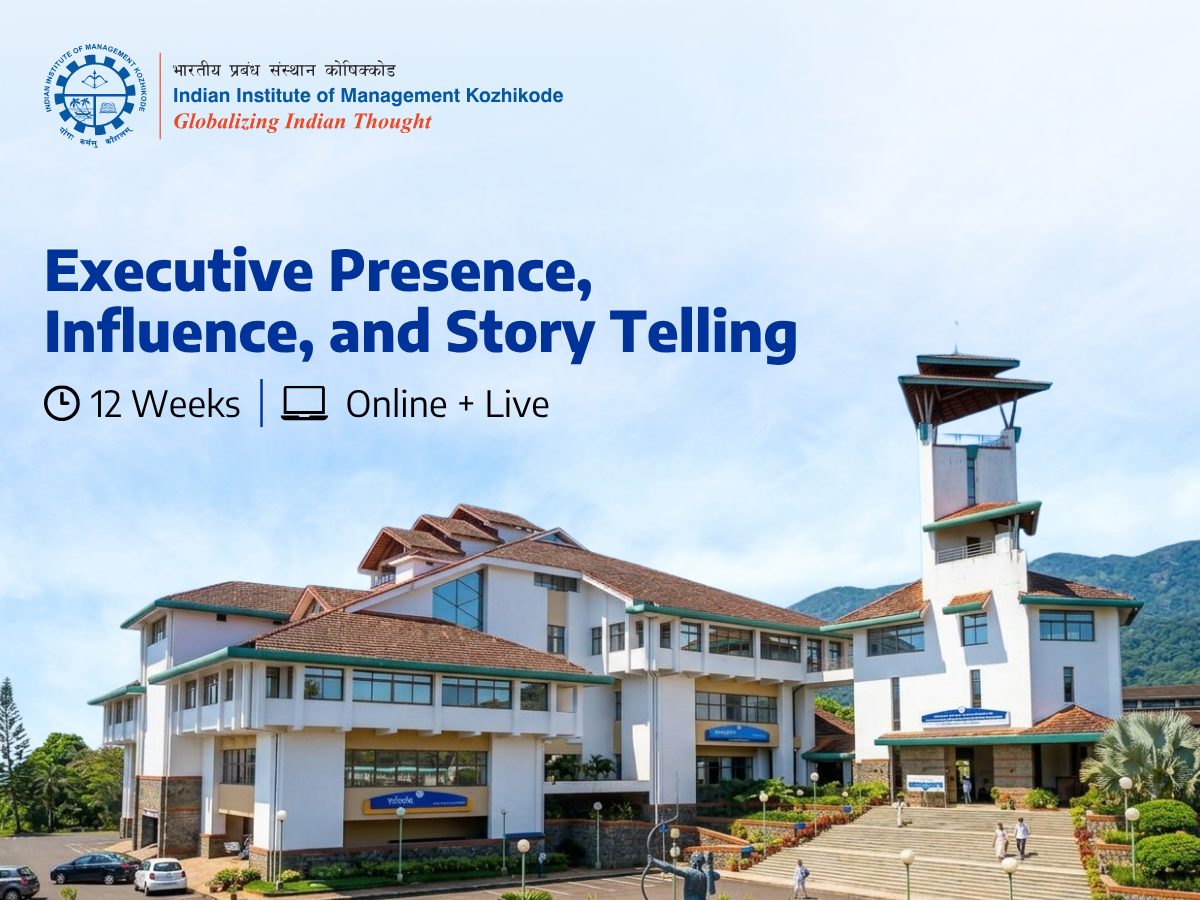
Recognising this shift, IIM Kozhikode's Executive Presence, Influence, and Storytelling Programme offers a structured approach to developing capabilities that are often acquired informally through years of professional experience.
The 12-week programme explores executive presence, self-awareness, verbal and non-verbal communication, strategic storytelling, persuasion, stakeholder management, emotional intelligence, personal branding, and cross-cultural influence.
Its emphasis extends beyond communicating with confidence to understanding how professional relationships, informal networks, and organisational dynamics shape decision-making.
Through faculty-led learning, masterclasses, peer discussions, and applied communication frameworks, the programme provides professionals with opportunities to examine how they present ideas, influence stakeholders, and navigate complex interactions.
For functional heads, consultants, aspiring CXOs, and senior professionals, these capabilities become particularly relevant as their responsibilities expand beyond individual performance towards enterprise-wide collaboration.
The Future of Leadership May Belong to Those Who Can Create Alignment
Organisations do not move forward on strategy alone. They move when people understand the strategy, believe in its relevance, and commit to executing it.
As business structures become more interconnected, senior leadership may increasingly be defined by the ability to turn expertise into understanding, understanding into alignment, and alignment into collective action.
For professionals aspiring to broader responsibilities, the question is no longer simply whether they have the knowledge to make the right decisions.
It is whether they can bring others along when those decisions matter.
Because in modern enterprises, the person with the most authority is not always the person with the greatest influence.
For professionals looking to build this kind of influence, IIM Kozhikode’s Executive Programme in Executive Presence, Influence and Storytelling offers a structured learning experience to strengthen their leadership capabilities. Explore the programme to understand how it can support your professional growth.