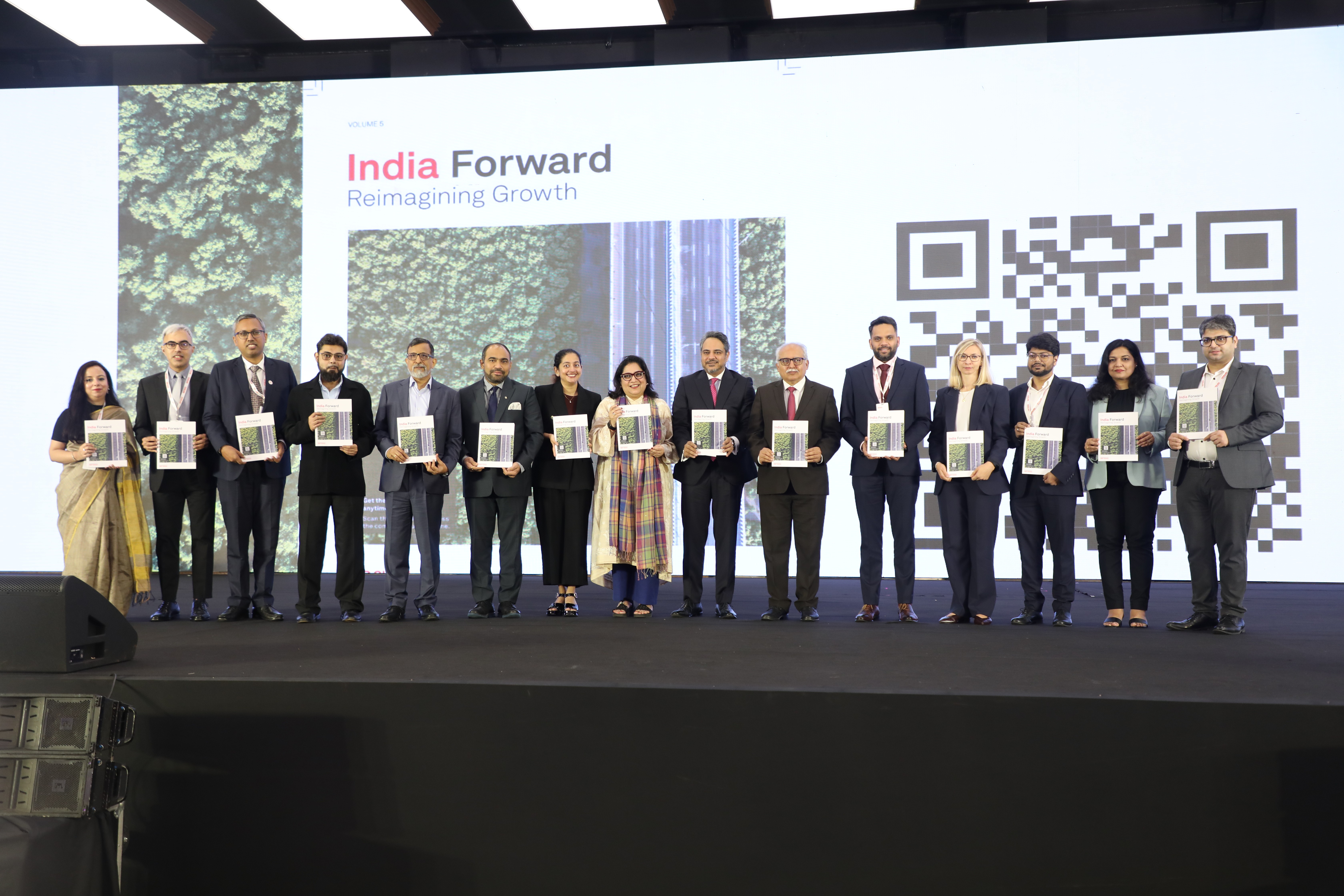
Bangalore, Oct 01: India's economy grew 7.8% in fiscal 2025-26, significantly outperforming expectations despite high US tariffs and global uncertainty, according to the S&P Global India Research Chapter's latest report, "India Forward: Reimagining Growth." Growth is expected to moderate to about 7.0% in fiscal 2026-27, as India's next phase of development will depend on how effectively it converts macroeconomic resilience into sustained momentum.
Yann Le Pallec, President, S&P Global Ratings, and Chairman of Board for Crisil, said,
“India has a significant opportunity to convert macroeconomic resilience into sustained economic momentum. Our research suggests that the country can build on this momentum by advancing the next phase of physical infrastructure development, supported by competitive federalism, deeper capital markets and more robust financial intermediation.”
Dave Ernsberger, President, S&P Global Energy, highlighted in the report that
“The disruption to energy supplies through the Strait of Hormuz has been a severe test of energy security for high-growth Asia. India, which relies heavily on the Strait of Hormuz for oil, refined products, gas and adjacent supply chains, has faced reductions in crude and LPG of 20% and 12%, respectively, as well as a drop in LNG of 16%. Economic resilience and energy security are critical as India responds to this continuing supply shock.”
The India Research Chapter's latest report features seven original thought leadership articles from analytical teams across S&P Global and Crisil, examining how India is navigating a complex landscape of opportunities and challenges. Additional key findings from the report include:
- India's economy grew 7.8% in 2025-26, significantly outperforming expectations despite high US tariffs and global uncertainties. Growth is expected to slow down to about 7.0% in 2026-27. The growth outperformance underscores the strength of India's domestic drivers and its ability to navigate an increasingly uncertain global environment.
- India is likely to continue to position itself as a leading power, rather than a balancing power, to convey its intent to become a more dominant international player. The next iteration of India’s geopolitical strategy will likely involve compartmentalized cooperation with major powers and holistic engagement with emerging economies.
- More than half of India’s crude imports move through the Strait of Hormuz, leaving it among the most exposed countries to the waterway’s effective closure. The crisis has highlighted the need to strengthen energy security in Asia by diversifying supply sources and to create strategic reserves for crude oil, refined products and, where feasible, gas. India must build integrated storage, diversified supply chains and energy security for a more resilient future.
- The digital rupee could become the fourth layer of India's digital public infrastructure, embedding rules directly into money. In a tokenized global economy, the digital rupee could keep cross-border business-to-business trade and remittances anchored in sovereign currency, preventing a shift toward foreign-currency stablecoins.
- The Indian capital market has grown considerably in size and depth over the past decade. Few major markets have combined strong economic growth, a deep and expanding listed equity universe, and a broad spectrum of companies ranging from emerging domestic champions to globally competitive firms. As of June 30, 2026, the Indian equity market, stood at USD $2.03 trillion in investable market capitalization.
- The next phase of India’s energy transition will be shaped by climate ambition and the need for resilience in an increasingly uncertain world. The Strait of Hormuz is a reminder of how external energy risks can sharpen the case for self-reliance. The key challenge for the power sector is to build a system that can deliver clean, reliable and affordable electricity at scale.
- In the wake of the Strait of Hormuz crisis, India's E20 program has advanced from a fuel-blending mandate into a broader energy security option. Its sustainable implementation will be shaped by ecosystem readiness and sustainable feedstock supplies while keeping pace with increasing demand.
“India Forward” is prepared by S&P Global and Crisil’s cross-divisional India Research Chapter, an initiative of the S&P Global India Leadership Council. This Chapter provides distinct thought leadership on India by combining local expertise, global perspectives and its full suite of capabilities.