13 November 2026: The Sanrivatti ONE has made its world debut. Revealed for the first time at the company’s headquarters in the Netherlands, the show car gives the world its first complete look at Sanrivatti’s debut hypercar, unveiling the ONE name, its arresting exterior design and an ambitious technical specification centred on a naturally aspirated Judd V10.
The ONE is the physical expression of a simple but provocative idea: what if a hypercar were designed around the driver before the machine? Conceived around Sanrivatti’s radical head-forward Apex Position, the car combines an unconventional driving philosophy with lightweight engineering, expressive aerodynamics and a deliberately analogue character.
Its 5.5-litre Judd V10 is targeting 800 hp (597 kW) at 9,000 rpm and 700 Nm of torque, delivered to the rear wheels through a six-speed Hewland sequential gearbox. With a target dry weight of 1,100 kg and projected maximum speed of 330 km/h (205 mph), the ONE is designed to put formidable performance at the service of a more immediate connection between human and machine. The stated output and performance figures are provisional development targets, not validated results.
Santiago Sánchez Rivero, Founder and CEO of Sanrivatti, said: “When we started Sanrivatti, we didn’t want to create another hypercar that simply followed the established formula with more power and more technology. We wanted to question something more fundamental: what it actually feels like to drive.
“The ONE is the first time people can see how that belief has shaped a complete car, from the position of its driver to its exterior proportions and the engine we have chosen. The figures are exciting, of course, but they are only part of the story. We are building the ONE to make every moment behind the wheel more physical, instinctive and rewarding.”
Judd V10 power, engineered for involvement
At the heart of the ONE sits a naturally aspirated 5.5-litre Judd Power V10. Its targeted 800 hp at 9,000 rpm promises the high-revving response, mechanical character and soundtrack that have made naturally aspirated racing engines so evocative. Rather than pursuing electrification or complexity simply to inflate headline figures, Sanrivatti has selected a powertrain intended to make every driver input feel immediate.
A mid-engined, rear-wheel-drive layout supports that objective. The carbon-fibre monocoque forms the foundation of an architecture targeting a dry weight of just 1,100 kg, corresponding to a calculated power-to-target-dry-weight ratio of approximately 727 hp per tonne. Proposed running gear includes double-wishbone pushrod suspension with independent heave and roll, AP Racing carbon/carbon ventilated brakes, Braid forged magnesium-alloy wheels and Michelin slick tyres.
John W Judd, Managing Director, Judd Engines, said: “A naturally aspirated V10 is about far more than the headline power figure. Of equal importance is the way an engine responds, builds through its rev range and connects the driver’s inputs to the performance of the car.
“Sanrivatti’s philosophy gives that character a clear purpose. The 5.5-litre V10 is a compelling engineering foundation for a car built around directness, responsiveness and the experience behind the wheel. We look forward to supporting the programme as it advances.”
A diving falcon. A fighter aircraft. One unmistakable silhouette
The design of the Sanrivatti ONE draws from two worlds rarely brought together so directly: the peregrine falcon in a high-speed dive and the precision of modern fighter aircraft. Led by designer Robin van Tilborg, the exterior uses every line and volume to communicate speed and purpose, while responding to the demands of the vehicle’s unusual cockpit architecture.
A continuous signature line sweeps along the side, evoking the trajectory of a peregrine falcon diving towards its prey. From above, a pronounced coke-bottle form reveals broad, seemingly floating front shoulders tapering around a narrower body, echoing both the diving bird and the angular forms of Sanrivatti’s emblem. Flowing panels meet crisp intersections and sharp character lines, balancing sculptural drama with intended aerodynamic efficiency.
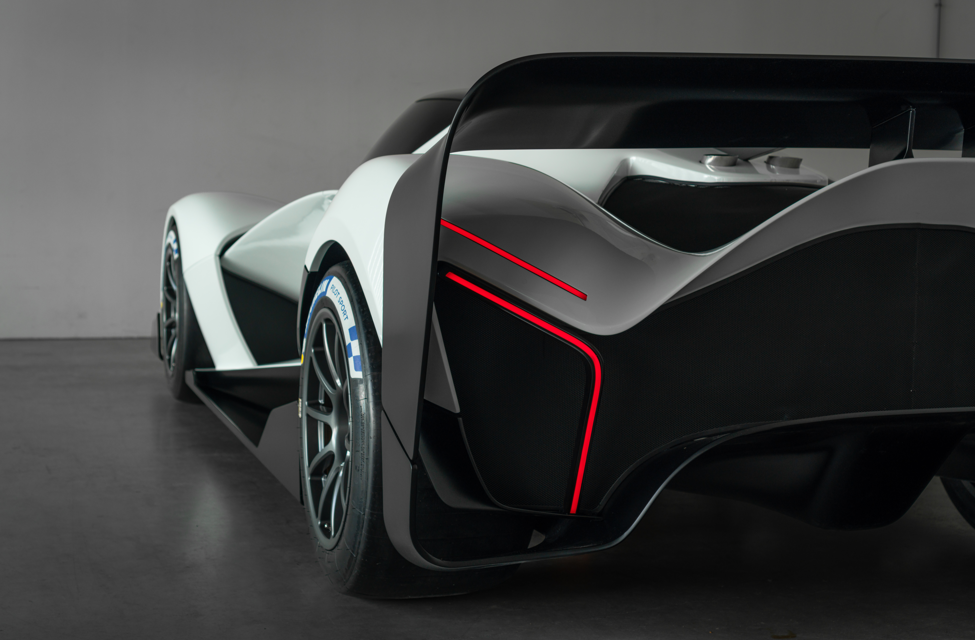
Its single-piece canopy, inspired by fighter-aircraft cockpits, integrates into the body rather than sitting above it as a conventional cabin. At the nose, two dramatic jet-inspired intakes feed air tunnels passing through the car, creating open volumes that reduce visual mass and contribute to the intended aerodynamic design. Slim headlights and matching rear light graphics trace the body’s signature lines.
At the rear, open bodywork is intended to promote airflow and dissipate engine heat. A large wing rises from the diffuser, accompanied by a smaller integrated lip spoiler spanning the rear shoulders. The resulting composition is muscular and technical without relying on ornament for its own sake.
“The peregrine falcon was a powerful influence because its form is defined by purpose. In a dive, every part of its body contributes to the movement, and we wanted that same combination of elegance, precision and aggression in the ONE,” said Santiago.
“Fighter aircraft shaped the canopy, front intakes and the relationship between fluid surfaces and sharp edges. But our task was never just to make a dramatic-looking car. The architecture and every line needed to have a reason to exist.”
Apex Position: an entirely different point of view
Behind the show car’s extraordinary exterior lies Sanrivatti’s defining innovation: the Apex Position. Instead of reclining behind the front axle as in a conventional hypercar, the driver adopts a supported, head-forward posture, positioned more centrally and farther forward. Inspired by the physical immediacy of a high-performance motorcycle, the concept reshapes posture, sightlines, control positioning and the relationship between the human body and the car.
That philosophy is already being explored through a working proof-of-concept and dedicated digital and physical simulators. In comparative virtual testing at Corner Three of Silverstone Circuit, the Apex Position showed an average of 3.2 times more visible racing surface than the ten benchmark hypercars and track cars assessed at the same location. The result measures visible track surface in simulation, not an independently verified improvement in lap times or real-world driving performance.
The canopy and forward-focused proportions of the ONE flow directly from that driver-first packaging. Further proprietary body-support and control technologies are being developed to allow the driver to move more naturally with the vehicle while remaining supported and secured.
From a distinctive idea to a world-debut show car
Sanrivatti first emerged publicly in May 2026, presenting its ambition to change what driving feels like. Subsequent announcements introduced the Apex Position, the engineering and leadership expertise behind the programme, and new visibility findings. The unveiling of the ONE now brings those strands together for the first time in a complete exterior design.
Founder Santiago Sánchez Rivero, who grew up in Uruguay and studied automotive engineering in the Netherlands, is supported by an international design and engineering team, together with specialist technical partners. Paul Arkesden, Executive Director of Technology Partnerships, brings more than three decades of high-performance automotive experience, including senior engineering roles at Singer Vehicle Design and McLaren Special Operations and involvement in the McLaren P1 programme.
Paul Arkesden, Executive Director of Technology Partnerships at Sanrivatti, said: “Creating an exceptional hypercar is difficult enough. Creating one around an entirely different driving position means rethinking the relationship between packaging, structure, aerodynamics, ergonomics and controls from the outset. That is what makes the ONE so interesting.
“The exterior now shows how that philosophy is taking shape, while the V10 and wider technical specification underline the scale of the engineering ambition. There is substantial development and validation still to come, but we have a distinctive foundation on which to build.”
The world-debut show car showcases the ONE’s intended exterior form, proportions and engineering direction. Detailed vehicle systems, final performance and production specifications will continue to be developed and validated as the programme progresses towards a bespoke running prototype and eventual track testing. Sanrivatti’s initial priority remains a track-focused driving experience, with further details of the development programme to follow.
For Sanrivatti, the unveiling marks an important step from philosophy to physical form. For the driving enthusiast, it offers the first full view of a hypercar conceived not simply to go faster, but to make speed feel different.