Tokyo, Nov 19: External Affairs Minister S Jaishankar has underscored the growing strategic importance of India-Japan relations, saying a stronger partnership between the two Indo-Pacific nations can make a significant contribution to shaping the emerging global order.
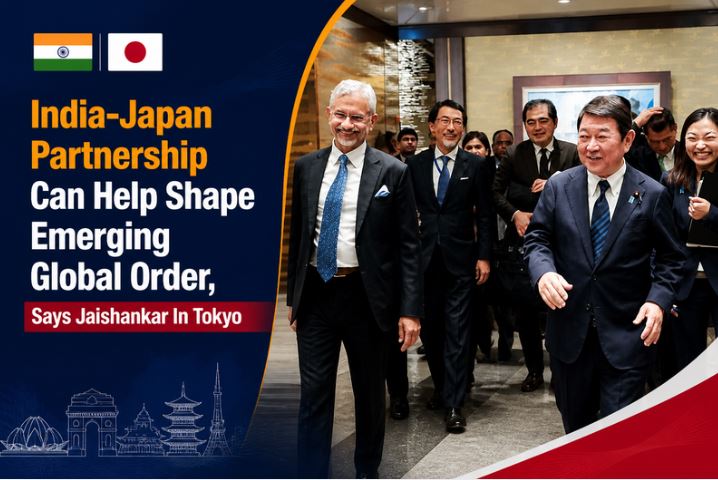
Representational Image
Addressing a joint press conference in Tokyo on Thursday, Jaishankar said India and Japan, backed by their longstanding friendship and shared strategic interests, have an important role to play in addressing emerging international challenges.
He was speaking alongside Defence Minister Rajnath Singh, Japanese Defence Minister Shinjiro Koizumi and Japanese Foreign Minister Toshimitsu Motegi following the conclusion of the India-Japan Foreign and Defence Ministers' Dialogue, popularly known as the 2+2 Dialogue.
Jaishankar described the discussions as an important step towards strengthening bilateral cooperation and expanding the two countries' contributions to international affairs.
He pointed out that the global environment is undergoing significant changes, with ongoing conflicts, economic uncertainty and the continuing consequences of the Covid-19 pandemic creating fresh concerns over energy, trade, food and health security.
In this backdrop, he stressed that reliable international partnerships have become increasingly important for countries seeking to protect their strategic and economic interests.
Shared Vision For A Free And Open Indo-Pacific
Highlighting the strategic significance of the Indo-Pacific region, Jaishankar reiterated India's commitment to working with Japan and other like-minded partners to maintain a free, open and stable regional order.
He noted that both countries share common objectives in the region and are also working alongside their partners in the Quad framework.
The External Affairs Minister observed that changing geopolitical realities require nations to move beyond traditional assumptions and take greater responsibility for promoting international stability and global welfare.
He said India and Japan discussed a broad range of issues during the 2+2 meeting, covering bilateral, regional and international cooperation.
Supply Chain Security And Maritime Cooperation In Focus
Jaishankar also raised concerns over the increasing use of connectivity networks, natural resources, essential services, supply chains and market access as instruments of geopolitical pressure.
He emphasised that such developments have direct implications for national security, making it essential for countries to strengthen their resilience and explore alternative sources and supply routes.
Referring to disruptions and security concerns in the Gulf region, he highlighted the importance of protecting strategic connectivity routes and international trade networks.
The minister also stressed that uninterrupted maritime commerce is vital to the global economy and called for stronger maritime cooperation between India and Japan.
He underlined that both countries recognise the importance of ensuring safe and smooth maritime trade while respecting international law.
Push For A Multipolar Asia And World
Outlining the broader vision behind the bilateral relationship, Jaishankar said India and Japan support the emergence of a multipolar Asia and a multipolar global order.
He also reiterated their shared commitment to reforming multilateral institutions to make global governance more representative and responsive to contemporary challenges.
75 Years Of India-Japan Diplomatic Relations
During his visit, Jaishankar joined Japanese Foreign Minister Toshimitsu Motegi in unveiling the official logo commemorating the 75th anniversary of the establishment of diplomatic relations between India and Japan, which will be celebrated in 2027.
Earlier, the two ministers held the 19th India-Japan Foreign Ministers' Strategic Dialogue, reviewing the full range of bilateral engagement.
According to Jaishankar, discussions focused on strengthening economic security and expanding government-to-government, business-to-business and people-to-people partnerships. Regional developments, geopolitical challenges and multilateral cooperation were also discussed.
The External Affairs Minister additionally met Taro Aso, Vice President of Japan's Liberal Democratic Party, and exchanged views on strengthening strategic, economic and energy security cooperation.
He also met former Japanese Foreign Minister Taro Kono at the LDP headquarters.
The series of high-level engagements reflects the growing importance both countries attach to their strategic partnership, particularly at a time when geopolitical shifts are reshaping international relations and economic cooperation.