Sep 18: Every day, millions of flowers are offered at temples and places of worship across India. But once the prayers are over, the petals and garlands often become part of the country’s growing waste-management challenge. A new wave of recycling initiatives is changing that story by turning discarded flowers into incense sticks, soaps, natural colours, compost, textiles and other marketable products.
What was once treated as waste is increasingly being viewed as a raw material. The idea is at the heart of the circular economy — keeping materials in use for longer, reducing waste and creating economic value from resources that would otherwise be thrown away.
From temple waste to useful products
The process begins with something as basic as proper collection and segregation. Used flowers are gathered from temples and separated from plastic, metal, threads and other non-organic material. The flowers are then cleaned, dried and processed depending on the product being made.
Dried petals can be ground into powder and used in incense products. Natural extracts and colours can be obtained from flowers such as rose, marigold and hibiscus for soaps, textiles and other applications. The remaining organic material can also be directed towards composting or other forms of processing.
This creates a simple but effective waste-to-value chain: collect, segregate, process, manufacture and sell.
Women at the centre of the green economy
One of the most promising aspects of floral-waste recycling is the role being played by women’s self-help groups.
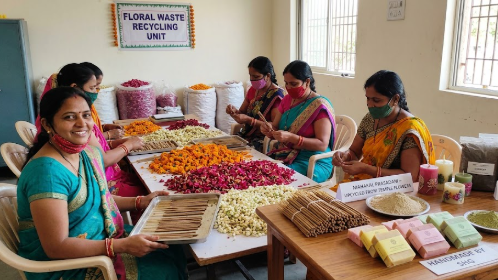
At several religious centres, women are involved in sorting flowers, preparing raw material, making finished products and packaging them for sale. These activities provide opportunities for women to earn income locally while participating in environmentally responsible businesses.
At Ujjain’s Mahakaleshwar Temple, for example, several tonnes of floral and other waste are generated each day because of the temple’s large visitor base. The collected material is processed into products such as incense, compost and briquettes, with women from a self-help group involved in making products from the recovered flowers.
Similar initiatives are being developed in different parts of the country, showing that waste management can become a livelihood opportunity when communities are given the right skills, infrastructure and market access.
A market beyond incense sticks
Incense remains one of the most familiar products made from temple flowers, but entrepreneurs are increasingly looking at higher-value applications.
Floral waste can be used to develop natural dyes for fabrics, soaps, candles, organic fertilisers, decorative products and eco-friendly colours. This diversification is important because it allows businesses to target different consumer segments rather than depending on a single product.
For example, floral waste collected from Mumbai’s Siddhivinayak Temple has been used for developing natural dyes for textiles. In other parts of the country, recycled flowers have been converted into incense products and organic inputs.
These products also fit into a growing consumer interest in natural and environmentally conscious alternatives.
Cities see waste as an economic resource
Municipal bodies are increasingly recognising the value of organised floral-waste collection.
Kolkata Municipal Corporation announced plans in June 2026 to recycle temple flowers and garlands into products such as herbal colours and incense sticks, while also creating livelihood opportunities for women involved in the process.
Such initiatives can create a local ecosystem involving temples, municipal authorities, self-help groups, startups and private enterprises.
Temples can provide segregated floral waste, local authorities can facilitate collection and processing, while women-led groups and businesses can manufacture, package and market the finished products.
This approach can reduce the quantity of organic waste entering dumpsites and water bodies while creating a new source of income.
Turning an environmental challenge into business opportunity
The environmental case for better floral-waste management is equally important. Although flowers are biodegradable, large quantities dumped into rivers, ponds and other water bodies can affect water quality and aquatic ecosystems.
A report highlighted by UNESCO in July 2026 noted the scale of floral waste generated from religious offerings in India and pointed to the need for better waste-management practices.
The solution does not necessarily require complicated technology at every location. In many cases, better segregation at the source, regular collection and small-scale processing units can make a significant difference.
Digital marketing can take green products further
For small enterprises and self-help groups, producing sustainable goods is only one part of the challenge. Reaching customers is equally important.
Digital marketing can help women-led enterprises and small businesses showcase their products through social media, online marketplaces and their own digital channels. Stories about where the flowers came from and how they were transformed can also give these products a distinctive identity.
This can help local producers reach customers beyond temple towns and nearby markets. Better branding, attractive packaging, online payments and social-commerce platforms can further improve their ability to compete with established consumer-product businesses.
Building a circular economy from the ground up
The growing movement around floral-waste recycling reflects a larger change in how India approaches waste. Instead of seeing discarded material only as something that needs to be removed, businesses and communities are increasingly looking at what value can be recovered from it.
The model also connects several priorities — cleaner cities, women's livelihoods, entrepreneurship, sustainable consumption and resource conservation.
For India's temples and cities, the opportunity is significant. A flower offered in devotion does not have to become waste once the ritual ends. With organised collection, community participation and access to markets, those discarded petals can return to the economy as useful products and new sources of income.
What begins as a handful of wilted flowers can, with the right system, become a small business, a livelihood and a meaningful step towards a more circular and sustainable economy.