New Delhi, Nov18: PHD Chamber of Commerce and Industry organised a conference on “GST Process Reforms: From Rate Rationalization to Trust-Based Compliance” and “Decoding the 57th GST Council: Less Discretion, More Trust” at PHD House, New Delhi, on Wednesday. The conference examined the next phase of GST reforms, with discussions centred on simplifying compliance procedures, streamlining refunds, improving input tax credit mechanisms, reducing discretionary intervention and strengthening trust between taxpayers and tax authorities. It also brought together policymakers, industry representatives and tax experts to deliberate on the implications of the 57th GST Council decisions and identify areas requiring further reform.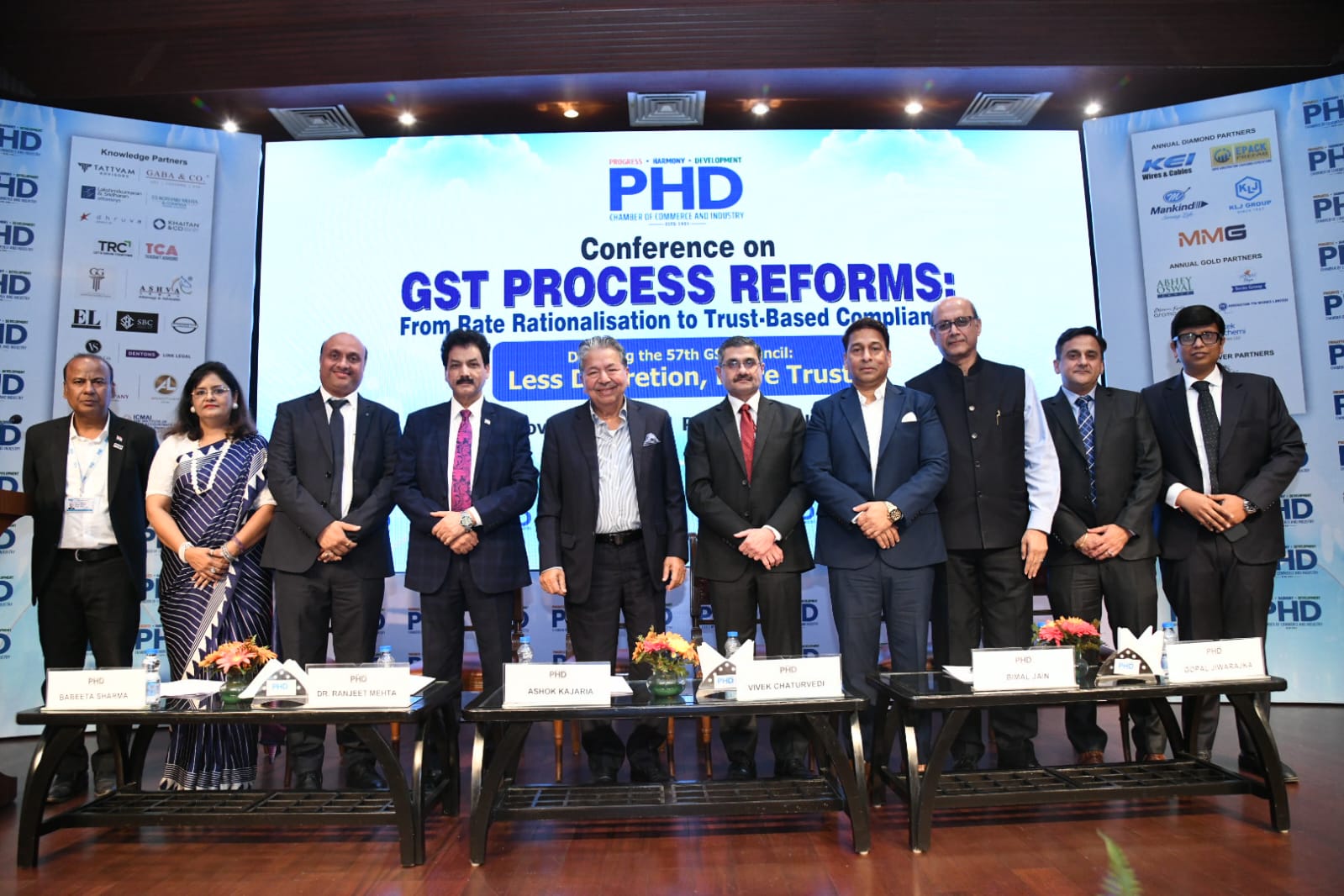
Mr. Vivek Chaturvedi, IRS, Chairman, Central Board of Indirect Taxes & Customs (CBIC), Ministry of Finance, said the GST Council’s October 8 recommendations marked a shift towards a “Trust First, Verify Later” approach, placing compliant taxpayers at the centre of tax administration and recognising honest taxpayers as key partners in nation-building. He said GST, founded on the vision of “One Nation, One Tax, One Market,” has emerged as a landmark reform contributing to Viksit Bharat 2047. He outlined three key priorities of the GST Council: rate rationalisation to bring greater clarity and efficiency, ease of compliance through automation and faster refunds, and trust-based governance with greater confidence in bona fide taxpayers.
Highlighting major enforcement reforms, he noted the proposed withdrawal of arrest powers under Section 69 of the CGST Act, which reflects a shift from coercive enforcement towards a collaborative partnership between government and industry. He also noted the increase in the prosecution threshold from ₹2 crore to ₹5 crore and the rationalisation of offences under Section 130. On refunds, he highlighted automated processing of nearly 90% of low-risk claims, expanded ITC refund provisions for input services under the inverted duty structure and for capital goods used in zero-rated supplies, and phased automation of refunds for exporters.
He also announced the discontinuation of routine interception of goods in transit, with checks restricted to intelligence-based cases subject to Joint Commissioner-level authorisation. The move is expected to reduce transit delays and ease logistics operations across states.
For MSMEs, key relief measures include simplified registration, use of e-commerce warehouses as principal places of business by eligible suppliers, an optional annual return with quarterly tax payments for eligible businesses with turnover up to ₹5 crore, and conditional late-fee relief. On dispute resolution, he highlighted a proposed ₹10,000 minimum threshold for show-cause notices and standardisation of adjudication and appeal orders.
He further outlined a new GST administration framework for nearly 70 lakh registered taxpayers, envisaging centralised administration for large taxpayers and faceless assistance for others. This is in line with the differentiated compliance framework highlighted by the Hon’ble Finance Minister at the 57th GST Council meeting, with proportionate compliance requirements for large and small taxpayers. A draft of the faceless framework will be released for public and stakeholder consultation. Concluding, he said the future of GST administration lies in simplification, transparency, technology and mutual trust, ensuring ease of doing business while safeguarding revenue interests.
CA (Adv.) Bimal Jain, Chairman, Indirect Taxes & GST Committee, PHDCCI, highlighted the growth in GST collections from an average of ₹90,000 crore per month in 2017 to ₹2.31 lakh crore in October 2026. Describing GST as a transformative reform that subsumed 17 indirect taxes and 23 cesses, he noted its role in eliminating tax cascading, encouraging MSME formalisation and creating a unified national market. Welcoming measures to streamline compliance and improve liquidity, he highlighted automated GST registration, faster refunds, 90% provisional refunds for non-risky taxpayers, extension of ITC refunds to input services under the inverted duty structure, and proposed refunds of eligible capital goods credit for zero-rated supplies from April 2027. He also welcomed the rationalisation of blocked ITC and the removal of credit reversal on expired goods.
Flagging industry priorities for the next GST Council and calling for GST 2.0, he urged:
- protection of genuine buyers by reconsidering Section 16(2)(c), so that bona fide buyers are not denied ITC because of supplier defaults
- prospective rather than retrospective cancellation of GST registration
- rationalisation of penal provisions, avoiding proceedings over minor tax amounts
- reconsideration of the 18% interest rate on delayed payments, particularly for MSMEs
- transfer of electronic credit ledger balances between entities under the same PAN to ease working capital constraints
“The real success of GST 2.0 lies in simplifying compliance, protecting honest taxpayers, reducing litigation and strengthening mutual trust between taxpayers and tax administration,” he said, adding that a simple, transparent and taxpayer-friendly GST regime is essential for achieving the vision of Viksit Bharat 2047.
Addressing the gathering, Mr. Gopal Jiwarajka, Former President, PHDCCI, said a change in the mindset of tax administration towards trust and facilitation was as important as policy reforms. He called for a review of suo motu and retrospective cancellation of GST registrations, particularly where such action could disrupt business operations, affect bank accounts and penalise genuine buyers through ITC reversals. He also stressed that prosecution should follow only after a case is established through investigation, and that genuine errors or differences in interpretation must be distinguished from deliberate fraud. While welcoming the proposed withdrawal of arrest powers under Section 69, he urged the authorities to examine the difficulties faced by taxpayers already subject to arrest proceedings and related bail conditions.
Dr. Ranjeet Mehta, CEO & Secretary General, PHDCCI, said the success of GST should be measured not merely by revenue collection but by its contribution to simplifying procedures, lowering the cost of doing business and enabling economic activity. He said the next phase of GST reforms must build on the progress of market integration and rate rationalisation by strengthening trust, simplifying compliance and improving industry confidence. He added that PHDCCI had recently submitted recommendations to the CBIC Chairman and that the conference was an important platform to consolidate industry inputs for further reforms.
Mr. Sandeep Garg, Co-Chair, PHDCCI, said the effectiveness of a tax system should be measured not only by revenue collection but also by its ability to build taxpayer confidence, encourage compliance and promote business growth. Welcoming the proposed safeguards under Section 86A, he said taxpayers should have an opportunity to present their case before restrictions are imposed on their electronic credit ledger. He also called for a similar opportunity before suspension of GST registration, noting that such action could disrupt the functioning of an entire business and affect its supply-chain relationships.
The conference featured three technical sessions: “Process Reforms under GST: Simplifying Returns, Refunds and Compliance Administration”; “Exports, Refunds and Enforcement Reforms: Balancing Facilitation with Revenue Protection”; and “ITC Reforms: Unlocking Credit Flow, ISD Challenges and the Future of Input Tax Credit.” Industry representatives, tax professionals and experts deliberated on the implementation of the Council’s recommendations and outstanding issues requiring policy intervention.
The conference concluded with a call for sustained government-industry dialogue to address outstanding GST concerns, strengthen taxpayer confidence and advance a transparent, predictable and facilitative tax regime. Participants emphasised the need to translate the Council’s recommendations into effective implementation to further improve ease of doing business.